Synthesizers come in three meaningfully different types: compact desktop synths, performance keyboard synths, and full-size keyboard synths. The split is keyboard size, because that changes playability, portability, and how much control you get at the instrument. Measure your own space and playing needs first, then compare them with the key count and voice count that matter for your use.
Synthesizer Types Among the Listings We Screened
| Type | What sets it apart | Listings we screened | Price range | Median sequencer steps |
|---|---|---|---|---|
| Compact desktop synths | keys up to 25 keys | 7 | $119 to $399.99 | 16 steps |
| Performance keyboard synths | keys 25 to 49 keys | 24 | $198.80 to $2999 | – |
| Full-size keyboard synths | keys 49 keys and up | 17 | $119 to $4999.99 | – |
Counted over the 84 listings this site screened; a listing that does not state the figure a type is defined by is not counted under any type.
If you are looking for low-end frequencies, see our comparison of the best synthesizer for bass.
Where these choices show up in our reviews
Prices across these 3 run from $119 to $334.42; each one has a full review here.
For modern sounds, look at our ranking of the best digital synthesizer.

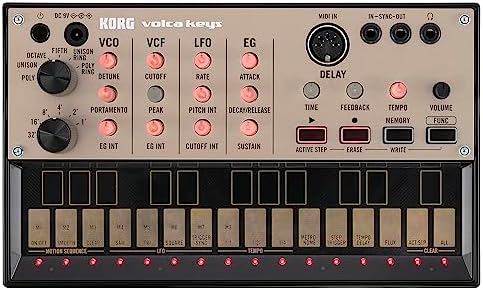

Compact Desktop Synths
Compact desktop synths are the smallest synth type, with up to 25 keys. They suit you when desk space matters more than two-handed playing, and when a sequencer matters more than a large keyboard.
Producers can find inspiration by viewing our guide to the best synthesizer for making electronic music.
This type is the closest fit for programming parts, sketching patterns, and keeping a setup portable. The median sequencer length in this group is 16 steps, which is enough for short riffs and repeating hooks, but not long evolving phrases.
To find the perfect vintage sound, explore our analysis of the best analog synthesizer.
The tradeoff is physical reach. A small keybed limits performance technique, so this type asks you to accept less room for chords and expressive two-hand parts.
Entry-level musicians should view our list of the best synthesizer for beginners under $500.
Compact desktop synths sit at the lower end of the price spread. In the listings we screened, they ran from $119 to $399.99, which keeps them below most performance keyboards and well below the priciest full-size models.
Consider browsing our roundup of the best portable synthesizer for on-the-go use.
Performance Keyboard Synths
Performance keyboard synths use 25 to 49 keys, which puts them in the middle ground for live playing and studio control. They suit you if you need a playable keyboard without moving up to a full stage footprint.
Check out our spec breakdown of the best synthesizer for live performance under $500.
This type gives you more room for chords than a compact desktop model, while staying easier to place than a full-size keyboard synth. The median polyphony here is 6 voices, so the category is built around practical parts rather than dense layered harmony.
For limited setups, browse our selection of the best compact synthesizer for small spaces.
That voice count is enough for many lead, pad, and split-keyboard uses. If your work depends on thick sustained stacks, you need to check the exact voice count carefully, because this type often trades depth for size.
Performance keyboard synths occupy the broad middle of the market. Their price range starts below the upper end of compact desktop models and extends into the premium segment, so this is where feature differences matter most.
Make sure you understand all the certifications and safety standards for synthesizers.
Full-Size Keyboard Synths
Full-size keyboard synths have 49 keys or more, so they are the type for players who need the most room under their fingers. They suit you when keyboard technique, splits, and two-handed parts matter more than compact placement.
If you are new to the hobby, see our primer on what a synthesizer is and how it works.
This type has the strongest case for traditional keyboard work. The median polyphony is 34 voices, which supports wider chords, layered sounds, and more sustained parts than the smaller types usually target.
Before buying, review our breakdown of what each price level gets you.
That extra range comes with a bigger footprint. If you need to move the instrument often, or fit it into a tight desk setup, this type asks for more space than the other two.
To clear up confusion, look at our guide to synthesizer terms and specs, explained in plain English.
Full-size keyboard synths also cover the widest price span. The listings ran from $119 to $4,999.99, so this type includes both accessible entry models and high-end instruments with more room for control and voice allocation.
Selecting the right interface is easy when you see how to choose your keys for synthesizers.
Synthesizer Type Comparison
| Type | Best-fit buyer | Main advantage | Main compromise |
|---|---|---|---|
| Compact desktop synths | Players who need a small footprint and pattern-driven work | Most portable format, with 16-step median sequencing | Least room for two-handed playing |
| Performance keyboard synths | Players who want a usable keyboard without a large chassis | Middle-ground key count for live parts and studio control | Median voice count is only 6 voices |
| Full-size keyboard synths | Players who need the widest key range and more sustained harmony | 34-voice median polyphony for larger chord work | Largest footprint and broadest price spread |
Which Synthesizer Type Fits Your Needs?
If your setup lives on a desk and you mainly build patterns, compact desktop synths fit that situation. A 16-step sequencer is enough for short repeating ideas, but the small key count is the limit you feel first.
You can find a classic recreation in our full review of the MODEL D.
If you play parts with both hands and still need a manageable size, performance keyboard synths fit that situation. The middle key range gives you more playability than a desktop unit, while keeping the instrument smaller than a full-size board.
For a unique portable workflow, look at our spec breakdown of the S-1.
If you need chords, splits, and more sustained layers, full-size keyboard synths fit that situation. The 34-voice median in this group matters when your parts stack notes instead of replacing them one at a time.
This versatile unit is covered in our full review of the microKORG.
JUNO-60 is a useful benchmark for subtractive poly synth workflow, because many buyers still use it as a reference for straightforward keyboard control. DX7 marks the classic digital FM reference, and the listings here show that this category also includes instruments with far more voices than a typical FM-era six-operator layout.
Study the features of this keyboard in our full review of the MX49BK.
MS-20 remains the reference point for raw analog character and patching behavior. If that style matters to you, the type decision still comes first, because keyboard size and voice count decide whether the instrument fits your playing situation at all.
Browse our other synthesizer pages
Top Discounts is reader-supported: some links on this page are affiliate links, and as an Amazon Associate Top Discounts earns from qualifying purchases at no extra cost to you. Learn more.