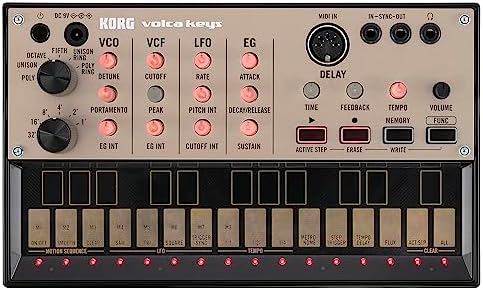
Korg Volca Keys
Volca Keys delivers three-voice polyphony, so it suits you if you want compact analog synthesis with hands-on control.
three-voice polyphony polyphony voices
- Polyphony voices
- three-voice polyphony
- Sequencer steps
- 16-step sequencer – at or above the 16-step sequencer reference figure
- Keys
- 27 touch-sensitive keys
1 deciding spec not stated
- MIDI DIN ports
- Not stated in the listing – confirm with the seller before ordering
Suits bedroom producers
- Bedroom producers
- Electronic music students
- Live loop performers
- Synth hobbyists building a first hardware rig
$361 under the category median
- This Synthesizer
- $119
- Median of the 84 Synthesizers we screened
- $479.50
- Range
- $118 to $4999.99
- Cheaper than this one
- 1 of those 84
Volca Keys Overview
Volca Keys shapes three-voice polyphony into chords for you if you need compact analog sound with 27 touch-sensitive keys.
If you want a small synth for desk use, 27 touch-sensitive keys change how you enter notes and keep the footprint tight. That matters most when you need a playable panel without a full keyboard.
Volca Keys fits that situation with three-voice polyphony, which gives you chord work in a compact analog synth. Its 16-step sequencer adds short-pattern control, and that is the strongest spec-based reason to consider it.
We screened 84 Synthesizers and this is one of 15 chosen for a full review. It made that list because full reviews go to the most-rated products that pass screening, at most 2 per brand. This one has 648 buyer ratings, the 3rd most of the 84 screened.
For those seeking a portable controller, see how the MX49BK performs in production.
How Top Discounts picked: we started from the 200 most-reviewed synthesizer listings in our retail dataset, removed duplicates, accessories and off-category products, and 84 qualified. This product is one of 15 from that pool chosen for a full review. Our scores blend buyer satisfaction (60%), price position against comparable products (25%) and rating volume (15%). Specifications come from manufacturer listings and ratings from verified Amazon buyer reviews (data checked November 2026).
The Short Answer on the Volca Keys
Best for: you want an analog synth with 27 touch-sensitive keys, a 16-step sequencer, and simple hands-on pattern building.
Choose the Volca Keys if you want that setup at around $119.
- Pro: Three-voice polyphony lets you play chords and short pads, which monophonic synths cannot do.
- Pro: The 16-step sequencer gives you enough pattern length for short riffs and repeating loops without external gear.
- Pro: It states both AC adapter and battery power options, so you can place it on a desk or move it away from mains power.
- Con: Three voices limit harmonic density, so sustained four-note chords are out of reach.
- Con: The 27 touch-sensitive keys are compact, which narrows the playing surface for buyers who want a full keyboard layout.
Don’t buy this if: you need four-voice polyphony for fuller chords and pads.
Price assessment: $119 is low for a synth with analog sound, 16-step sequencing, and touch-sensitive keys.
Top Discounts score: 9.2/10 (data-driven – see “How we picked” above)
Many producers prefer these options when looking for the most space-efficient compact synthesizers.
Newcomers should consult our list of best synthesizers for beginners under $500.
Full Specifications for this Synthesizer
| Polyphony voices | three-voice polyphony |
| Sequencer steps | 16-step sequencer |
| Keys | 27 touch-sensitive keys |
| Power supply | AC adapter |
| Built-in speaker | Yes |
| Audio input | Yes |
| Battery-operated power option | Yes |
| Delay | Yes |
| Motion sequencing | Yes |
| Sync capability with Volca series devices | Yes |
Polyphony voices most separates Volca Keys here. Polyphony voices measures how many notes the synth can sound at the same time.
Where this sits in the buyer data: Among the 84 products screened for this category, this one’s 4.5 rating places it #36, on 648 ratings – above the 46-rating median of that group, so the average rests on more feedback than most of its comparables. On price it undercuts 80 of them.
What These Specifications Let You Do
Three-Voice Layers for simple chords and pads
Volca Keys gives you three-voice polyphony, so you can play simple chords, pads, and stabs without reducing every part to a single note. That voice count is enough for triads and compact harmony, but it keeps thicker four-note voicings out of reach.
For a first-time synth buyer, that trade-off matters because three voices favor tight parts over full keyboard-style chord writing. If you want sustained harmony or layered riffs, you need to arrange with restraint; if you want dense chord blocks, a four-voice synth is the usual floor in this category.
Motion Sequencing for short patterns and bass loops
The 16-step sequencer lets you build short patterns, bass loops, and repeating phrases without external gear. A 16-step pattern length is enough for the short loop work most buyers expect, and it supports hands-on riff building in a compact format.
That same length also sets the limit: you can sketch complete ideas and live loops, but longer song sections need pattern changes or outside sequencing. Volca Keys gives you enough space for a repeating part, not a full arrangement in one pattern, so it suits quick sequence writing more than extended song construction.
Hands-On Control with 27 touch-sensitive keys
Volca Keys gives you 27 touch-sensitive keys and knobs for real-time control, so you can enter notes and shape a part without a computer. The touch keys keep the keyboard compact, and the control layout favors quick edits while you build a line or chord part.
Those 27 keys also define the playing surface: they are enough for short phrases and pattern entry, but not for a wide piano-style range under both hands at once. The battery-operated power option and AC adapter option make it easier to place the synth where you need it, while the built-in speaker and audio input add simple standalone use for practice or quick patching.
The Volca Keys Job by Job: What Its Figures Cover
The Volca Keys against the jobs buyers ask about, worked out from its listed sequencer steps and a typical need for each job.
| Job | What it takes | Volca Keys |
|---|---|---|
| Build 16-step bass riffs and short patterns by hand | at least 16 steps | Yes – 16 steps |
| Make FM-style digital textures for electronic production | at least 16 steps | Yes – 16 steps |
| Run a simple live set with hands-on pattern changes and no computer | at least 16 steps | Yes – 16 steps |
| Program a short live loop that repeats without external gear | at least 8 to 16 steps | Yes – 16 steps |
The Volca Keys Against Similar Synthesizers
If you want a compact synth with a 16-step sequencer, Volca Keys gives you that pattern length for $119. It also states three-voice polyphony, 27 touch-sensitive keys, and a battery option alongside AC power.
- Against the Korg Nu:Tekt NTS-1 MKII, Volca Keys has the longer sequencer at 16 steps versus 8.
- Against the Waldorf Streichfett, Volca Keys is the more direct pick for hands-on playing, because it states 27 touch-sensitive keys while Streichfett’s listing centers on a 12-program patch layout instead.
- Against the Behringer 130 Dual VCA, Volca Keys is the closer match for a self-contained synth, since it states three-voice polyphony and a 16-step sequencer rather than a VCA-focused signal tool.
- Against the Korg Volca Kick/Bass, Volca Keys is $9.99 cheaper at around $119 versus $128.99.
- Against the Behringer TD-3-BK, Volca Keys is $30 cheaper and ties it on sequencer length at 16 steps.
If you want a competitor instead, pick the Korg Nu:Tekt NTS-1 MKII when price and a digital kit format matter more than the extra sequencer length. Pick the Waldorf Streichfett when your priority is its 128-voice strings section and 12 programmable patches.
What the deciding spec costs here: Measured as price per unit of Sequencer steps, the reviewed product works out to $7.44 against a $13.27 median across the 25 other screened products that state the spec, and 6 of them deliver more of it per dollar. The cheapest screened product that beats its 16-step sequencer is the SONICWARE LVN-010 at $259 with 128-step, so more of the spec that decides this category starts $140 above this one.
If you are interested in frequency modulation, you can read our full Volca FM review.
Setting Up This Synth, and What Support Covers
Getting the Volca Keys ready to play
An AC adapter is the one item you need before the Volca Keys does anything useful.
- Connect the AC adapter to the power input and use a supply that matches the unit’s adapter requirement.
- Set the synth on a stable surface with room for its 27 touch-sensitive keys and front-panel knobs.
- Turn on the power and confirm that the 16-step sequencer is ready for pattern entry.
- Play a note or chord on the 27-key touch surface, then use the knobs for real-time control.
- Link the Volca Keys to other Volca series devices if you want sync, and match the cable type to the sockets on both units.
Warranty and support checks for This Synthesizer
Warranty cover varies by seller and country.
- Confirm the return window for the AC adapter, because the synth will not run without external power if the battery option is unavailable to you.
- Confirm whether the seller includes the correct MIDI cable, because this listing does not state the MIDI DIN port count.
- Confirm whether you need a USB cable, because this listing does not state USB-MIDI for computer connection.
- Confirm whether a sustain pedal is supported, because the listing does not state a pedal jack and the touch keys already define the playing surface.
The first thing to do on arrival is power it up with the adapter and verify that the 16-step sequencer responds before the return window closes.
Synth Buying Questions Answered
Sync and control in a mixed setup
Volca Keys states sync capability with Volca series devices, and it also has a MIDI-style sync path only through that listed feature, not a full MIDI DIN port count. That means you can treat it as a compact partner for other Volca units, but the data here does not state USB-MIDI or MIDI DIN support for outside gear.
Price versus what you give up
At around $119, Volca Keys gives you three-voice polyphony, a 16-step sequencer, and 27 touch-sensitive keys. The trade-off is the voice count: three notes at once is enough for simple chords and pads, but it is not the four-voice floor many buyers expect for broader harmony work.
Battery use away from a wall outlet
Yes, Volca Keys can run on batteries, and the listing also states an AC adapter power option.
How many notes can Volca Keys play at once?
Volca Keys has three-voice polyphony. That means it can sound three notes together, which suits simple chords and stacked intervals but not four-note harmony. Think of it like a three-slot tray: once all three slots are full, the fourth note has nowhere to go.
Does Volca Keys have enough steps for short patterns?
Yes, Volca Keys has a 16-step sequencer. That is enough for short riffs and looping patterns, and the product data also says it can handle hands-on pattern changes without a computer. If you want longer phrases, you will need a different workflow or more than one pattern.
Can I play Volca Keys without a computer?
Yes, Volca Keys can be used without a computer because it has 27 touch-sensitive keys, knobs for real-time control, and a built-in sequencer. The listing also states audio input and a built-in speaker, so it can sit in a small hardware setup on its own. The missing detail is MIDI DIN or USB-MIDI, so the data here does not promise a direct computer link.
Is the built-in speaker enough for private practice?
Volca Keys states a built-in speaker, so it can make sound without external monitoring. For quiet practice, that speaker may be useful; for a larger room, the specs here do not settle the question.
Consider exploring the best alternatives to a traditional synthesizer for different sound design workflows.
Is the Volca Keys Right for You?
Who the Volca Keys suits and the jobs it is the wrong choice for, listed below with the reason for each.
Who the Volca Keys is for, and what it does well
Who this synth suits
- Bedroom producers — three-voice polyphony, 16-step sequencing, and touch-sensitive keys make it easy to sketch chords, basslines, and patterns in a small setup
- Electronic music students — the analog sound engine, motion sequencing, and real-time knobs suit learning synthesis and hands-on sound design
- Live loop performers — battery power, sync capability with Volca series devices, and compact touch keys fit portable jam setups
- Synth hobbyists building a first hardware rig — the low price, delay, and simple sequencer give a practical entry point into analog sequencing
- Songwriters making demo tracks at home — three-note chords and a 16-step sequencer help build quick harmonic ideas without a full keyboard workstation
What this synthesizer handles well
- Bassline sketching — three-voice polyphony and the 16-step sequencer support quick pattern building
- Chord stabs and pads — three-voice polyphony lets you play simple chords instead of only single notes
- Hands-on sound tweaking — real-time control knobs make parameter changes immediate while playing
- Portable jam sessions — battery-operated power option and compact touch-sensitive keys support mobile use
- Syncing a small Volca setup — sync capability with Volca series devices supports chained rhythm and sequence timing
- Animated filter and effect movement — motion sequencing and delay support evolving patterns over time
What the Volca Keys is the wrong choice for
- Full piano practice — 27 touch-sensitive keys and three-voice polyphony are too limited for proper two-handed keyboard work
- Complex layered arrangements — three-voice polyphony restricts dense chords and overlapping parts
- Detailed step programming for long songs — the 16-step sequencer is too short for extended arrangements without constant chaining or resampling
- Expressive velocity-based playing — touch-sensitive keys do not provide a full weighted or velocity-sensitive piano feel
What to budget alongside the Volca Keys, and what to skip
Accessories worth buying with this synth
- Audio cable — needed to send the synth output to speakers, an audio interface, or a mixer
- Power adapter — needed if you do not want to rely on battery power for regular use
- Headphones — needed for silent practice because the unit does not provide built-in monitoring
- Small amplifier or powered speaker — needed to actually hear the analog synth in a room
- MIDI or sync cable — needed to connect timing with other Volca series devices or external gear
Accessories you can skip buying for this synthesizer
- Full-size keyboard stand — the compact 27-key format is usually used on a desk or tabletop, not a large stand
- External effects pedal for basic delay — the built-in delay already covers simple echo-style processing
- Large polyphonic keyboard upgrade — three-voice polyphony means a bigger chord-capable keyboard would be wasted if you only need this unit’s role
Where to Buy This Synthesizer
In November 2026 the Volca Keys was listed at $119. Prices move, so read that as a snapshot, not a quote.
Synthesizers are sold by the retailers below – we do not track which of them has the Volca Keys in stock, so check availability and the current price with the retailer before making a trip.
- B&H Photo Video (online and physical stores) — breadth of range for pro audio and music production gear
- Musician’s Friend (online only) — broad catalog and frequent comparison shopping for music instruments
- Amazon (online only) — broad marketplace selection from multiple sellers
- Sam Ash (online and physical stores) — music-instrument specialist retail and trade-in options
- Thomann (online only) — breadth of range and cross-border selection for niche synths
- Sweetwater (online and physical stores) — specialist staff and a broad range of music gear
- Guitar Center (online and physical stores) — in-store returns and used or open-box stock
Final Verdict on the Volca Keys
If you want an analog synthesizer with 27 touch-sensitive keys and a 16-step sequencer, the Volca Keys is a practical pick at around $119.
Its three-voice polyphony matters most. That count lets you build chords and layered parts, while the 16-step sequencer supports short riffs and live pattern changes without external gear.
Skip it if: you need four voices for fuller chords, or you want a keyboard with more than 27 keys for wider playing range.
Top Discounts is reader-supported: some links on this page are affiliate links, and as an Amazon Associate Top Discounts earns from qualifying purchases at no extra cost to you. Learn more.