Our Top 3 Analog Synths
The best analog synthesizer is the Moog Subsequent 37, and its 37 keys suit you if you want a keyboard-focused analog synth with performance control.
3 picks, 3 different buyers. Find the one whose description sounds like you and stop reading.

#1 – Moog Subsequent 37
Best for: you want 37 keys, aftertouch, and 256 stored presets in a keyboard synth with USB-MIDI and audio input.
Why the Moog Subsequent 37 is our #1 pick
- Listed at $699 in November 2026 – premium among those compared; the price moves, so check it
- 4.6 rating from 100 ratings
Polyphony voices: 2-note · Keys: 37
To put that polyphony voices in context, pick #2 states 16-Voice and pick #3 states three-voice polyphony.

#2 – Behringer K-2
Why the Behringer K-2 is our #2 pick
- Listed at $229 in November 2026 – entry among those compared; the price moves, so check it
- 4.6 rating from 63 ratings
Polyphony voices: 16-Voice
For comparison on polyphony voices, pick #1 states 2-note and pick #3 states three-voice polyphony.
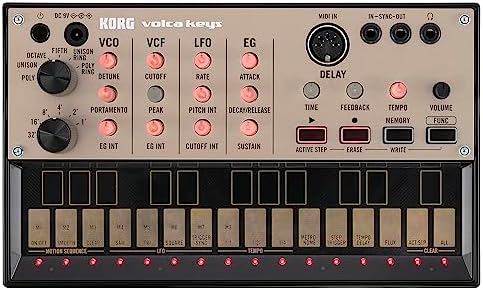
#3 – Korg Volca Keys
Best for: you want a portable analog synth with 16-step sequencing, touch-sensitive keys, and battery or adapter power.
Why the Korg Volca Keys is our #3 pick
- Listed at $119 in November 2026 – entry among those compared; the price moves, so check it
- 4.5 rating from 648 ratings
Polyphony voices: three-voice polyphony · Sequencer steps: 16-step sequencer
Against the other picks on polyphony voices, pick #1 states 2-note and pick #2 states 16-Voice.
If you are on a budget, explore our list of live performance synths under $500.
How Top Discounts picked: we started from the 200 most-reviewed synthesizer listings in our retail dataset, removed duplicates, accessories and off-category products, and 84 qualified. The picks on this page were selected from those 84 candidates against this topic’s requirements. The order of the picks reflects fit to this topic; each shows its rating and the number of ratings behind it, so you can weigh how much to trust it. Specifications come from manufacturer listings and ratings from verified Amazon buyer reviews (data checked November 2026).
Our Pick and How the List Was Built
If your setup needs a small stage footprint and simple hands-on control, a compact analog synth can save space without giving up sequencing.
Korg Volca Keys is the compact choice here, with 27 touch-sensitive keys, a 16-step sequencer, and battery or AC adapter power. If you want more keyboard range and aftertouch, the Moog Subsequent 37 is the stronger fit. If you want more voices for stacked parts, the Behringer K-2 is the one to look at instead.
We screened 84 Synthesizers at Top Discounts and kept 10 for this page because they matched analog buyer needs and covered the price spread from $119 to $699. The median price of the 10 products in our comparison is $344.88.
Understand the boundaries of this guide by viewing the article scope.
Identify your essential needs by checking the minimum requirements.
See the best options immediately in our top picks.
You can find our full review of the MicroFreak for a deeper look at its specs.
Synths: The Findings in Brief
- Top pick: Moog Subsequent 37 at $699 (Polyphony voices: 2-note).
- Also picked: Behringer K-2 at $229; Korg Volca Keys at $119.
- We compared 10 Synthesizers, from $119 to $699, median $344.88.
- Best buyer rating in the comparison: Korg monologue MONOLOGUEBK at 4.7/5 from 326 ratings.
Synthesizers Compared Side by Side
| Product | Price | Rating |
|---|---|---|
| Moog Subsequent 37 | $699 | 4.6 (100 ratings) |
| Behringer K-2 | $229 | 4.6 (63 ratings) |
| Korg Volca Keys | $119 | 4.5 (648 ratings) |
| Korg monologue MONOLOGUEBK | $315.76 | 4.7 (326 ratings) |
| Behringer MODEL D | $489 | 4.5 (193 ratings) |
| Behringer Neutron | $429 | 4.6 (172 ratings) |
| Roland SE-02 | $374 | 4.6 (162 ratings) |
| Behringer TD-3-MO-SR Modded Out Analog Bass Line Synthesizer | $199 | 4.6 (113 ratings) |
| Behringer Odyssey | $469 | 4.1 (67 ratings) |
| Korg MS20 Mini | $315.05 | 4.4 (179 ratings) |
Prices are approximate and move frequently – check the current price before deciding.
Among our top picks, Behringer K-2 is the value leader, and that matters here because polyphony per dollar helps you stretch an analog synth budget.
Each Synth We Picked, Examined One by One
The 3 picks below are reviewed in the same order as the cards above.
Moog Subsequent 37
The Subsequent 37 is the right first look here if you want a keyboard synth with performance controls and a deeper front panel. Its 37 semi-weighted keys, 40 knobs, and 74 switches give you more direct control than compact analog synth options, and the 256 presets help with recall.
What we like: The 37-key layout gives you a full playing surface, and the velocity and aftertouch support add more expression than a basic mini-key board. USB-MIDI, MIDI In/Out, audio input, and a headphone output make it easier to fit into a studio setup without extra adapters.
Keep in mind: Its 2-note paraphonic keybed is the limiting factor if you need three-note chords or sustained pads without note dropouts. If you want an analog synthesizer for chord work, this one is not the right fit.
Behringer K-2
The K-2 is the value pick for a buyer who wants an analog synth with enough note capacity for chords, leads, and patching-focused work. At around $229, it keeps the price low while still listing 16-voice polyphony and a semi-modular layout.
What we like: The dual VCO design and pure analog signal path point to a straightforward subtractive structure, and the semi-modular architecture gives you more routing flexibility than a fixed-layout desktop synth.
Keep in mind: The dimensions are compact at 5.35 x 16.69 x 3.74 inches, so this is the least keyboard-like option in the group. Power is not stated, so you should only plan around the connections and format that are listed.
Korg Volca Keys
The Volca Keys is the easiest entry point here if you want a compact analog keyboard synth with a simple control set and a built-in speaker. Its 27 touch-sensitive keys, 16-step sequencer, and battery or AC adapter power options suit a small setup that needs portability.
What we like: The 16-step sequencer gives you a practical pattern length for riff building, and motion sequencing adds movement without needing a larger rig. Audio input and sync capability with Volca series devices make it easier to slot into a small hardware setup.
Keep in mind: Three-voice polyphony limits how much harmony you can stack at once, so this is not the choice for fuller chord parts. The touch-sensitive keys also make it a less traditional playing surface than the Moog’s 37-key bed.
Learn how to select your model using the buying guide.
Space is limited, so consider compact synthesizer options for small spaces.
How to Choose a Synthesizer
Oscillator Count And Tuning Stability
Look for at least two oscillators if you want thicker subtractive layers, and treat tuning stability as a separate question from count. The Moog Subsequent 37 states 2 Variable Waveshape Oscillators plus a square wave sub oscillator and an analog noise generator, so its voice architecture favors flexible tone shaping over high voice count. The Behringer K-2 states a dual VCO design, which gives you two oscillator sources for classic analog lines. The Roland JUNO-60 is the benchmark for subtractive poly synth sound and workflow; the Moog’s 2-note paraphonic keybed points in a more performance-focused direction than that classic poly approach.
Filter Character And Resonance Behavior
Weigh filter character and resonance behavior before you pay for more oscillator count, because this is where many analog synths separate in use. The K-2 states a high-pass and low-pass filter design with peak and resonance, and that combination is the clearest raw-analog reference point in this group. The Moog Subsequent 37 adds external input and filter feedback, so its filter section is built for routing and self-interaction rather than simple tone trimming. The Korg MS-20 is the benchmark for raw analog character and patching behavior, and the K-2’s semi-modular architecture with default routings is the closest match here.
How modulation routing depth expands a synth’s sound
Prioritize modulation routing depth if you want one synth to cover more than a fixed lead sound. The Subsequent 37 states 2 modulation busses with LFO and programmable routing, which gives you a clearer route into movement than a fixed-layout panel. Its control surface also lists 40 knobs and 74 switches, so the routing is meant to stay hands-on. The K-2 states a semi-modular architecture with default routings, which suits buyers who want patching options without starting from a blank panel.
How keyboard size and playability affect synth performance
Keyboard size and playability matter most if you want to perform lines instead of sequencing everything from another device. The Moog Subsequent 37 states 37 semi-weighted keys with velocity and aftertouch, so it gives you the most complete playing surface in this group. The Korg Volca Keys states 27 touch-sensitive keys, which is compact and portable, but it asks you to trade key span for size. If you want a keyboard synth for studio work, the 37-key layout is the one here that gives you the broadest playing range.
Patch Memory And Preset Recall
Patch memory and preset recall matter most when you need the same sound back on stage or in a session. The Subsequent 37 states 256 presets, which gives you the strongest recall story among the three picks. The K-2 does not state patch memory, so the listing leaves that question open. Do you need to jump between saved sounds during a set? The Subsequent 37’s 256 presets answer that need directly, while the Volca Keys listing focuses on motion sequencing and 16-step pattern work instead.
View the technical specs in the comparison table.
Find the perfect match for your style in the audience checklist.
We provide a detailed spec breakdown of the TD-3-BK to help you decide.
If these options don’t fit, explore the alternatives to a synthesizer for similar sounds.
The Jobs Buyers Ask About, Checked Against Each Pick
Each row is a job this page’s buyers ask about, worked out from each pick’s listed polyphony voices and MIDI DIN ports and a typical need for the job.
| What you want to do | What it takes | How each pick does |
|---|---|---|
| Play three-note chords and sustained pads without note dropouts | at least 4 voices | Moog Subsequent 37: no (2 voices); Behringer K-2: yes (16 voices); Korg Volca Keys: not stated |
| Sync it to other hardware with standard round MIDI cables | at least 1 ports | Moog Subsequent 37: not stated; Behringer K-2: not stated; Korg Volca Keys: not stated |
| Store a few sounds and recall them on stage | at least 4 voices | Moog Subsequent 37: no (2 voices); Behringer K-2: yes (16 voices); Korg Volca Keys: not stated |
| Make classic subtractive leads and pads for electronic tracks | at least 4 voices | Moog Subsequent 37: no (2 voices); Behringer K-2: yes (16 voices); Korg Volca Keys: not stated |
The needs are typical figures for each job, not manufacturer claims, and each pick’s result is worked out from its listed specifications. Your own job’s figure is the one that decides.
Who Buys Analog Synths, and What It Really Costs
Who buys a synth, and what each one needs
- Keyboard players in cover bands — at least 4 voices for chords and pads
- Electronic music producers — 16-step sequencer for hands-on riff building
- Home studio musicians — USB-MIDI for direct computer connection and DAW integration
- Live performers with hardware rigs — MIDI DIN ports for sync and control with other gear
- Film and game composers — patch memory for recalling sounds reliably
- Students learning subtractive synthesis — a classic benchmark like Roland JUNO-60 for familiar workflow context
What a synthesizer really costs, and where to buy one
What to budget for on top of the synthesizer
- MIDI cables — needed to connect to other hardware via DIN MIDI ports
- USB cable — needed for computer connection and DAW use
- Sustain pedal — needed for held notes and performance control
- Keyboard stand — needed to place the instrument at playing height
- Headphones or monitor speakers — needed to hear the synth clearly
What you can leave out of the budget
- External sound module — unnecessary because the synth already makes its own sounds
- MIDI interface — unnecessary when USB-MIDI handles direct computer connection
- Patch sheets — unnecessary if the instrument has patch memory for recall
- Extra sequencer box — unnecessary if the built-in 16-step sequencer covers your pattern work
Where this kind of product is normally sold
- Music instrument stores — hands-on testing, staff setup help, and normal return windows
- Large online retailers — broad price comparison, shipping convenience, and standard return handling
- Used gear marketplaces — lower upfront cost, but condition and warranty handling vary
- Pro audio dealers — stronger support for MIDI setup, bundling, and warranty processing
Learn about hardware needs in the setup and warranty notes.
Examine each model in depth within the detailed reviews.
Get quick answers to common queries in the FAQ.
Getting Started with Any of These Picks
Power and connections before you patch anything
The first thing all three synths need is power, because none of them works without it. Moog Subsequent 37 states batteries, Korg Volca Keys states an AC adapter, and Behringer K-2 does not state its power source.
- Moog Subsequent 37 needs batteries, so you should have fresh cells ready before you start. Its battery-powered format also makes it the only one here that does not tie you to a wall outlet.
- Korg Volca Keys needs an AC adapter, so plan for mains power in the space where you will use it. That matters more here because it is the only pick that states an adapter instead of batteries.
- Moog Subsequent 37 and Korg Volca Keys both state audio input, which lets you route outside sound through the synth path. Behringer K-2 does not state audio input, so do not assume that connection is available.
- Moog Subsequent 37 states MIDI In/Out/USB, so a MIDI cable or USB cable can fit into a computer or other gear setup. Korg Volca Keys states sync capability with Volca series devices instead, so its stated hookup is narrower.
What to verify before the return window closes
Cover differs by seller and country, so verify the physical details that matter for this kind of synth. The biggest risk is a missing or mismatched connection, since these units depend on power and signal routing.
- Check that the power method matches what you planned to use. Moog Subsequent 37 needs batteries, and Korg Volca Keys needs an AC adapter, so a mismatch stops setup immediately.
- Confirm the keybed or control format matches your workflow. Moog Subsequent 37 states 37 semi-weighted keys with velocity and aftertouch, while Korg Volca Keys states 27 touch-sensitive keys and Behringer K-2 is semi-modular with no keys stated.
- Verify the jacks you need for your studio are actually present. Moog Subsequent 37 states MIDI In/Out/USB, audio in/out, headphones out, and CV/GATE ins; those connections matter if you plan to use patch cables, control voltage, or a gate signal.
- Inspect the front panel for missing knobs, switches, or damaged sockets. Moog Subsequent 37 states 40 knobs and 74 switches, so a missing control is more than cosmetic on that model.
On the day it arrives, power it up first and confirm every stated connection works while a return is still possible.
What Buyers Still Want to Know About Synths
Should I choose a monophonic or polyphonic analog synthesizer for the music I want to make?
Choose a polyphonic analog synthesizer if you need chords or sustained pads, because voice count decides how many notes sound at once. The Moog Subsequent 37 states 2-note paraphony, so it suits lead lines and simple intervals better than stacked harmony. The Behringer K-2 states 16 voices, which leaves more room for chord work.
Will this analog synthesizer work without extra gear, or do I need an amp, interface, pedals, or MIDI controller?
Yes, some analog synthesizer setups work with less extra gear than others, but the listed outputs and inputs matter. The Moog Subsequent 37 states batteries, USB-MIDI, audio input, and a headphone output, so it covers direct practice and computer connection more fully than the others here. The Korg Volca Keys states an AC adapter, a built-in speaker, audio input, and sync capability with Volca series devices, while the Behringer K-2 does not state its power source.
Which analog synth gives the most hands-on control?
The analog synth with the most hands-on control in this group is the Moog Subsequent 37, because it lists 40 knobs and 74 switches. That kind of control suits you if you want direct parameter access instead of menu-heavy editing. The Korg Volca Keys keeps control compact with 27 touch-sensitive keys and real-time knobs.
Which compact analog keyboard synth is the easiest fit for a small setup?
The compact analog keyboard synth that is easiest to place is the Korg Volca Keys, because it measures 5.35 x 16.69 x 3.74 inches. The Behringer K-2 is also small at 5.35 x 16.69 x 3.74 inches, while the Moog Subsequent 37 is much larger at 14.76 x 26.77 x 6.69 inches. Think of it like choosing between a desktop sketchpad and a full-sized notebook: both work, but they occupy different amounts of space.
To understand the technical side, view our guide to synthesizer terms and specs.
Who Should Skip These Synthesizers
If you need four-note chords, sustained pads, or clocked pattern work, these three picks are the wrong tool. The Moog Subsequent 37 states 2-note paraphony, not full polyphony, and the Korg Volca Keys gives you 16 sequencer steps rather than a longer pattern length for bigger arrangements.
Look at a polyphonic synth with MIDI DIN or USB-MIDI if that is your job. If your setup depends on tight sync, choose a model that states clock or sync support before you buy. Short answer: this page is not for that use case.
The rest of our synthesizer guides
Top Discounts is reader-supported: some links on this page are affiliate links, and as an Amazon Associate Top Discounts earns from qualifying purchases at no extra cost to you. Learn more.