Our Top 3 Picks for Small Spaces
The best compact synthesizer for small spaces is the Korg Nu:Tekt NTS-1 MKII because its 8-step sequencer keeps short patterns moving for you if you want a tiny desk synth.
If you read one thing on this page, read these 3.

#1 – Korg Nu:Tekt NTS-1 MKII
Best for: you want a tiny synth kit with an 18-key multitouch keyboard and an 8-step sequencer for short patterns.
Why the Korg Nu:Tekt NTS-1 MKII is our #1 pick
- Listed at $119 in November 2026 – entry among those compared; the price moves, so check it
- 4.6 rating from 1,411 ratings
Sequencer steps: 8-step sequencer · Keys: 18

#2 – Arturia MicroFreak
Best for: you want a compact keyboard synth with 25 keys, pressure and aftertouch detection on each note, and step-based note editing.
Why the Arturia MicroFreak is our #2 pick
- Listed at $334.42 in November 2026 – premium among those compared; the price moves, so check it
- 4.5 rating from 803 ratings
Keys: 25-key
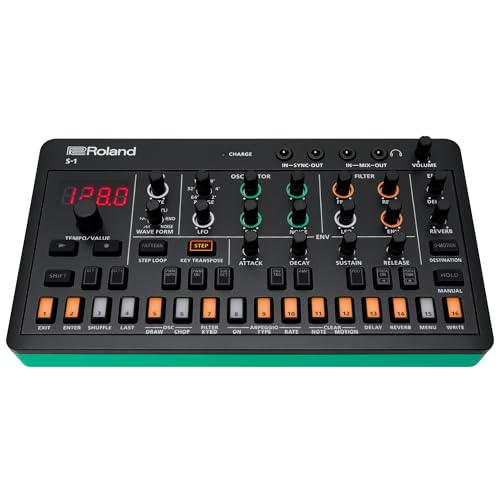
#3 – Roland AIRA Compact S-1
Best for: you want a four-voice micro polysynth with mono, poly, unison, and chord modes in a small desktop footprint.
Why the Roland AIRA Compact S-1 is our #3 pick
- Listed at $269.99 in November 2026 – mid-range among those compared; the price moves, so check it
- 4.5 rating from 190 ratings
Polyphony voices: four-voice
You might also prefer a mobile setup by exploring the best portable synthesizer options.
How Top Discounts picked: we started from the 200 most-reviewed synthesizer listings in our retail dataset, removed duplicates, accessories and off-category products, and 84 qualified. The picks on this page were selected from those 84 candidates against this topic’s requirements. The order of the picks reflects fit to this topic; each shows its rating and the number of ratings behind it, so you can weigh how much to trust it. Specifications come from manufacturer listings and ratings from verified Amazon buyer reviews (data checked November 2026).
What We Recommend and Why
If your setup lives on a narrow desk, the first thing to lose is often key count, not sound options, and that changes which synth makes sense.
Korg Nu:Tekt NTS-1 MKII fits that scenario with 18 keys and an 8-step sequencer in a very small body. Choose the Roland AIRA Compact S-1 if you want four-voice polyphony in a similarly small format, or the Arturia MicroFreak if 25 keys are worth the higher price. We screened 84 Synthesizers at Top Discounts and kept 10 for this page because we were looking for compact models that still covered the small-space use case.
The shortlist runs from $119 to $334.42, and the median price of the 10 products in our comparison is $174.49. That range shows the spread from the $119 NTS-1 MKII to the pricier MicroFreak and S-1 without drifting into bulkier layouts.
Start by learning the essential criteria in the buying guide.
Check the setup and warranty notes for information on technical requirements and support.
View the comparison table to see the technical specifications side by side.
Beginners should start by viewing how a synthesizer works and what it is.
Compact Synthesizers for Small Spaces: The Short Version
- Top pick: Korg Nu:Tekt NTS-1 MKII at $119 (Sequencer steps: 8-step sequencer).
- Also picked: Arturia MicroFreak at $334.42; Roland AIRA Compact S-1 at $269.99.
- We compared 10 Synthesizers, from $119 to $334.42, median $174.49.
- Best buyer rating in the comparison: Arturia MiniFreak at 4.8/5 from 128 ratings.
- Cheapest in the comparison that can program a short live loop that repeats without external gear: Korg Volca Keys at $119 (16 steps).
Synthesizers for Small Spaces Compared Side by Side
| Product | Price | Rating |
|---|---|---|
| Korg Nu:Tekt NTS-1 MKII | $119 | 4.6 (1,411 ratings) |
| Arturia MicroFreak | $334.42 | 4.5 (803 ratings) |
| Roland AIRA Compact S-1 | $269.99 | 4.5 (190 ratings) |
| Korg Volca Keys | $119 | 4.5 (648 ratings) |
| Korg VOLCABASS | $149.10 | 4.6 (307 ratings) |
| Korg Volca FM | $149.98 | 4.4 (557 ratings) |
| Behringer TD-3-BK | $149 | 4.5 (382 ratings) |
| Behringer TD-3-MO-SR Modded Out Analog Bass Line Synthesizer | $199 | 4.6 (113 ratings) |
| Korg monologue MONOLOGUEBK | $315.76 | 4.7 (326 ratings) |
| Arturia MiniFreak | $334.27 | 4.8 (128 ratings) |
Prices are approximate and move frequently – check the current price before deciding.
Korg Nu:Tekt NTS-1 MKII fits this topic best because its 5.08 x 3.07 x 1.54-inch body gives the smallest stated footprint among the picks.
The Full Review of Each Pick for Small Spaces
The 3 picks below are reviewed in the same order as the cards above.
Korg Nu:Tekt NTS-1 MKII
The NTS-1 MKII fits a small desk because it pairs an 18-key layout with a 5.08 x 3.07 x 1.54 inch body. Its 8-step sequencer and arpeggiator make it useful for short patterns and quick parts, and the USB connection keeps cabling simple in tight setups.
What we like: The 18-key multitouch keyboard gives you a playable surface without taking much room. Its arpeggiator helps turn held notes into repeating patterns, and the 8-step sequencer covers short loop ideas. At around $119, it is the most compact-priced route here into a small-space synth with sequencing.
Keep in mind: The 8-step sequencer is enough for short phrases, but it limits longer riff building. If you want a larger keyboard for two-handed parts, this is not the right fit.
Arturia MicroFreak
The MicroFreak suits a small room because it keeps a 25-key layout in a compact footprint while adding more performance control than a bare module. Its printed circuit board keyboard uses no moving parts, and the pressure and aftertouch detection on each note gives you more expression from the same narrow width.
What we like: The 25-key format is the strongest balance here if you want real playing room without a large chassis. It also records up to four automations, and the step-based note editing helps shape patterns without extra gear. The 5×7 modulation matrix gives you a lot of routing options for a synth this size.
Keep in mind: The PCB keyboard is a different playing surface from traditional moving keys, so you should choose it for layout efficiency rather than familiar key action. At around $334.42, it asks more budget than the smaller Korg option.
Roland AIRA Compact S-1
The S-1 is the smallest-feeling full synth here because it puts four-voice polyphony into a 10.25 x 6.6 x 3.5 inch body. That matters when you need chords in a tiny setup, since four voices is the floor for basic polyphonic pads and harmony.
What we like: Four-voice polyphony lets you play chords, not just single-note lines. The mono, poly, unison, and chord modes give you different ways to use the same compact panel, and the hands-on panel keeps the controls immediate. Its oscillator set includes square, sawtooth, sub, and noise, so it covers a useful range of basic synth shapes.
Keep in mind: This is the bulkiest of the three, so it is the right choice only if you want chord playability more than the smallest footprint. At around $269.99, it sits between the other two on price without matching the MicroFreak’s key count.
Review the minimum requirements to ensure the hardware meets your specific needs.
See our curated list of the top picks for a quick overview of the best options.
Find answers to common queries in the FAQ.
For a deeper dive into the hardware, view our full review of the J-6.
What to Look For in a Synth for Small Spaces
Desk Footprint for a Synth in Small Spaces
Desk footprint matters most when you need the synth to stay out of the way on a shelf or small table. The Korg Nu:Tekt NTS-1 MKII measures 5.08 x 3.07 x 1.54 inches, so it takes the least physical space among the picks here. The Roland AIRA Compact S-1 measures 10.25 x 6.6 x 3.5 inches, which is still compact, but it asks for more width and depth than the NTS-1 MKII. The MicroFreak uses a 25-key PCB layout, so its keyboard surface is larger than the NTS-1 MKII’s 18-key layout. For a compact synth guide, the size question separates the field more clearly than sound style. Roland JUNO-60 is the classic subtractive benchmark here, and these picks answer that idea with much smaller footprints. If your own space can only spare a narrow corner, measure the width and depth first; a smaller footprint wins when the desk is the limit.
Power And Cable Setup for a Small Desk Rig
Power and cable setup matters when you want fewer cords on a desk or in an apartment rig. The MicroFreak does not state its power connection in the data above, so you should treat its cable needs as unspecified here. The S-1 also does not state power in the provided specs. In this category, USB-MIDI is the common computer link, and the NTS-1 MKII states USB connector type, which fits that kind of setup. If you want the cleanest small-space layout, count the outlets and cables you can live with before you choose.
Hands-On Control Layout for Fast Editing
Hands-on control layout matters when you want fast editing without menu diving. The S-1 states a hands-on panel, and that wording matters in a small setup because it keeps performance controls on the surface. The NTS-1 MKII adds an arpeggiator, three LFOs, and an 8-step sequencer, so it gives you several control paths in a very small body. The MicroFreak’s 5×7 modulation matrix and four automation lanes point to deeper routing and motion control than a simple knob set. The JUNO-60 benchmark is known for straightforward subtractive workflow, and the S-1 sits closest to that kind of immediate control among these picks. If you prefer direct play over menu work, favor the layout you can reach without shifting your hands far from the keys.
Patch Storage for Practice, Recording, or Sets
Patch storage matters if you need the same sound back for practice, recording, or a set. The data above does not state patch memory for the NTS-1 MKII, MicroFreak, or S-1, so this is one feature you should verify before you rely on any of them for repeatable presets. That gap matters more in a compact synth because small size does not help if you cannot recall a sound later. The Korg MS-20 is the reference point for patching behavior, and that benchmark reminds you that routing and recall are separate questions. If you need saved sounds, make patch memory the first thing you confirm, because the spec set here does not answer it.
Headphone Output for Quiet Small-Space Playing
Headphone output matters when you need to play quietly in a room, but the provided specs do not state a headphone jack for any of these picks. That means the comparison here cannot rank them on silent practice, even though small-space buyers often need that function. The NTS-1 MKII’s USB connection and the S-1’s compact all-in-one format help with desk use, but neither spec list answers headphone routing. For this page’s topic, the missing headphone figure is a real gap, not a small detail. If quiet practice is part of your setup, treat the headphone jack as a must-check item before you buy.
If you are on a strict budget, see the best synthesizer for live performance under $500.
The Jobs Buyers Ask About, Checked Against Each Pick
Each row is a job this page’s buyers ask about, worked out from each pick’s listed sequencer steps and polyphony voices and a typical need for the job.
| What you want to do | What it takes | How each pick does |
|---|---|---|
| Program a short live loop that repeats without external gear | at least 8 to 16 steps | Korg Nu:Tekt NTS-1 MKII: only at the easier end (8 steps); Arturia MicroFreak: not stated; Roland AIRA Compact S-1: not stated |
| Store a few sounds and recall them on stage | at least 4 voices | Korg Nu:Tekt NTS-1 MKII: not stated; Arturia MicroFreak: not stated; Roland AIRA Compact S-1: not stated |
The needs are typical figures for each job, not manufacturer claims, and each pick’s result is worked out from its listed specifications. Your own job’s figure is the one that decides.
Who Buys Synthesizers, and What It Really Costs
Who buys a synthesizer, and what each one needs
- Apartment musicians — need a compact keyboard with at least 4 voices for basic chords and pads
- Beatmakers in small studios — need a built-in sequencer with 16 steps for hands-on riff building
- Laptop producers — need USB-MIDI for direct computer connection and DAW integration
- Hardware synth beginners — need MIDI DIN ports for standard hardware sync and control
- Keyboard students — need full-size keys, not mini keys or touch-only controls, for playing technique and velocity control
What a synth really costs, and where to buy one
What to budget for on top of the synth
- MIDI cable — needed to connect to other hardware through MIDI DIN ports
- USB cable — needed for computer connection and DAW use through USB-MIDI
- Power adapter — needed if the unit does not run from a built-in battery
- Keyboard stand — needed to keep the synth usable in a tight room without taking desk space
- Headphones — needed for silent practice in shared housing
What you can leave out of the budget
- External sequencer — unnecessary when the synth already has a built-in 16-step sequencer
- MIDI interface — unnecessary if the unit already has USB-MIDI for direct computer connection
- Separate controller keyboard — unnecessary if the synth already has playable keys
- Patch bay — unnecessary for buyers who only need straightforward setup rather than modular patching
Where this kind of product is normally sold
- Music instrument stores — usually offer hands-on testing, staff setup help, and warranty handling through the shop
- Large online retailers — often have broad price comparison, return windows, and easy bundle checkout
- Used gear marketplaces — can lower entry cost, but return terms and warranty support vary by seller
- Direct brand stores — usually provide clear warranty handling and current accessory bundles, with less room for price haggling
Explore the detailed reviews for an in-depth look at each individual model.
Understand the boundaries of this list in the scope.
What It Takes to Run One, and What to Verify
What you need before a compact synth works
Power is the first requirement here. The Korg Nu:Tekt NTS-1 MKII states USB connection, the Arturia MicroFreak uses a 25-key PCB keyboard, and the Roland AIRA Compact S-1 includes a hands-on panel and four-voice polyphony.
- The NTS-1 MKII needs a USB cable, because its connector type is USB. It is the one pick here that names a computer-style connection.
- The MicroFreak does not state USB in the deciding specs, so treat computer recording as separate from the keyboard itself. If you want to record into a computer, an audio interface may be needed.
- The S-1 is the most self-contained of the three, because it states a hands-on panel and four-voice polyphony. That makes it the easiest fit when you want a small setup with no external keyboard.
- None of these three states built-in speakers. If you want sound without headphones or external monitors, you need to plan for that separately.
What to verify when the box arrives
Cover differs by seller and country. On arrival, verify the parts that matter for a small synth before the return window closes.
- Confirm the power path first.
- Check the keys or control surface for damage. The NTS-1 MKII has 18 keys, the MicroFreak has 25, and the S-1 uses a hands-on panel instead of a full keyboard.
- Confirm the sequencer functions if you bought the NTS-1 MKII for looping. Its 8-step sequencer is the part that limits short pattern work.
- Look for the controls you will actually use. The S-1 states mono, poly, unison, and chord modes, so those mode controls matter more than decorative extras.
Power it up first, then press every key, pad, or mode control once while you can still return it.
If you need a dedicated bass machine, look at our spec breakdown of the VOLCABASS.
Synthesizers for Small Spaces: The Questions This Choice Raises
What extra gear do you need to use a compact synthesizer at home?
For home use, you usually need power, audio output, and a way to hear the compact synthesizer. The Korg Nu:Tekt NTS-1 MKII states USB power, while the Roland AIRA Compact S-1 states a 10.25 x 6.6 x 3.5 inch footprint and the Arturia MicroFreak states a 25-key PCB keybed, so the setup can stay small.
Is a compact synthesizer worth the price, or am I paying extra just for the small size?
Price makes sense when the compact synthesizer gives you a smaller footprint and the controls you need, not just a reduced shell. The NTS-1 MKII is around $119, the S-1 is around $269.99, and the MicroFreak is around $334.42, so the spread reflects different control layouts and feature sets rather than size alone.
Does a compact synth need class-compliant USB for computer use?
Yes, class-compliant USB matters if you want plug-and-play computer connection without extra drivers. The Korg Nu:Tekt NTS-1 MKII states USB, which is the connection type listed for direct computer use here.
Which compact synth gives you the most hands-on control?
The compact synth with the most hands-on control here depends on whether you want keys, sequencing, or direct knobs. The Arturia MicroFreak gives you 25 keys and a 5×7 modulation matrix, while the Roland AIRA Compact S-1 adds a hands-on panel and four voices for chord work.
Use the audience checklist to identify which synthesizer best fits your personal style.
Who Should Skip These Synths
If you need a compact synth for short loops, the Korg Nu:Tekt NTS-1 MKII gives you an 8-step sequencer and 18 keys. An 8-step pattern is enough for a short live loop at the easier end of that range, but it is not a long riff builder.
What if you want a tiny synth that still gives you a real keyboard? The Arturia MicroFreak uses 25 keys, so you get more physical range than the 18-key NTS-1 MKII in a small footprint. Its 25-key PCB layout also means the keybed is not a traditional moving-key design.
You should move up to a synth class that states a 16-step sequencer, or use the guide best synthesizer for making electronic music if your setup also needs broader pattern work. If you also need chords and sustained harmony, choose a polyphonic model instead of a monophonic one.
Top Discounts is reader-supported: some links on this page are affiliate links, and as an Amazon Associate Top Discounts earns from qualifying purchases at no extra cost to you. Learn more.