Snare pad size for an electronic drum kit should be 10 in to 14 in for most buyers. If you want a realistic stick target for rudiments and ghost notes, use at least 10 in; smaller pads work only when space or budget matters more than that target. Measure the snare area you will actually strike, not the shell or the whole kit footprint.
If you are just starting out, view our list of the best electronic drum kit for beginners.
Electronic Drum Kit Snare Pad Size Guide
| use case | recommended Snare pad size | why this number |
|---|---|---|
| realistic snare target for rudiments and ghost notes | at least 10 in | 10 in gives a more realistic stick target, which matters most for rim-zone control and quieter notes. |
| first electronic drum kit for a new player | 8 in to 10 in | This range balances space and accuracy. It stays close to the median 8 in while moving toward the 10 in target for better control. |
| practice in a tight room or apartment corner | 6 in to 8 in | Use the smaller end when footprint matters more than a wider strike zone. The listings we screened state sizes as low as 6 in. |
| drummers who want more rim-shot room | 10 in to 12 in | This range gives more margin around the stick path. It is the point where the snare starts to feel less cramped without pushing into oversized territory. |
| players who want the broadest striking area in this category | 12 in to 14 in | The largest stated sizes in the listings run to 14 in, so this range is for buyers who want the widest available target and do not need to save space. |
Products in this category with a full review here
Prices across these 3 run from $189.04 to $239.99; each one has a full review here.
Noise control is essential, so see our comparison of the best electronic drum kit for quiet practice.

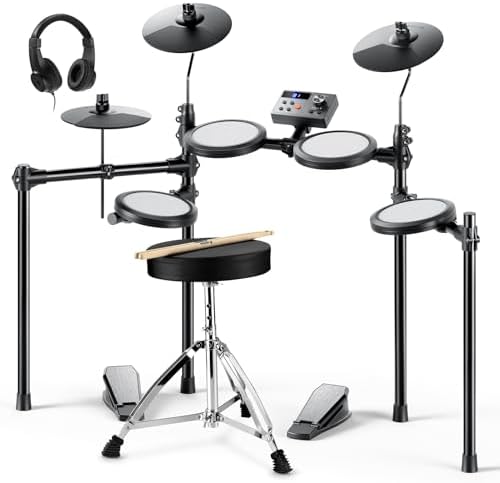

What happens if you go under or over?
Under 10 in, the snare pad gives you less room for clean stick placement, so ghost notes and rim work demand more precision. That matters most if you practice rudiments, because the stick has less surface to land on consistently.
High-quality audio matters for production, so see our guide to the best electronic drum kit for recording.
Overbuying usually means taking space you do not use. A 12 in to 14 in snare pad can help with comfort and rim control, but it also asks for more room on the rack and more clearance around nearby pads.
You can accelerate your progress by viewing the best electronic drum kit for learning drums.
The trade-off is simple: if your room is tight, a larger snare can crowd the rest of the kit; if your playing leans on accuracy, a smaller snare can make the same passages harder to place. The right size is the one that matches your reach, your practice material, and the space around the kit.
To keep the volume down while playing, see how to set up drum practice with headphones.
The mistake most buyers make with snare pad size
Most buyers focus on the snare pad number alone and ignore how much room they have to move the sticks. Snare pad size matters, but the real goal is a strike zone that matches your playing style and the space you can spare.
Beyond size, you should consider the total number of drum pads for electronic drum kits.
If you play simple beats and keep the kit in a cramped room, a median-sized pad can be enough. If you work on rudiments, open-handed patterns, or quiet ghost notes, prioritize the 10 in threshold before you chase a larger figure.
Understanding your budget is vital, so see what electronic drum kits cost at every price level.
Protect your investment by checking the electronic drum kit warranties before you buy.
Check the width of your snare area and the gap around it. If that space is tight, choose the smaller end of the range; if the area is open, move up only when the extra surface helps your stick placement.
Newcomers should start by viewing an electronic drum kit explained and how it works.
How snare pad size interacts with other limits
Snare pad size stops helping when the rest of the kit becomes the limit. A larger snare does not fix single-zone pads, a missing hi-hat controller input, or rubber pads that change the feel of the whole setup.
If you need something compact, see our full review of the Pyle Tabletop Drum Set.
Single-zone pads matter because they remove rimshots and separate articulations, so a bigger snare cannot replace that lost control.
For a budget-friendly option, see our full review of the MUSTAR U6010300200.
Sound library size is another separate limit. A kit can have a large snare pad and still feel narrow if the built-in sounds are limited, because pad size affects the target area, not the number of voices.
A highly-rated entry-level option is found in our full review of the DED-100.
If you are deciding between a larger snare and a more complete input set, choose the input set first when you need expansion. If you are choosing between two kits with the same pad layout and trigger support, then snare pad size becomes the more useful difference.
Check out our full review of the AED-400 for a detailed spec breakdown.
Browse our other digital drum set pages
- The Electronic Drum Kits That Work Best for Beginners
- Which Electronic Drum Kit Is Best for Apartment Practice?
- Best Electronic Drum Kit for Kids
- Electronic Drum Kits for Quiet Practice Compared
- Choosing the Best Electronic Drum Kit for Small Spaces
- The Electronic Drum Kits That Work Best for Home Use
Top Discounts is reader-supported: some links on this page are affiliate links, and as an Amazon Associate Top Discounts earns from qualifying purchases at no extra cost to you. Learn more.