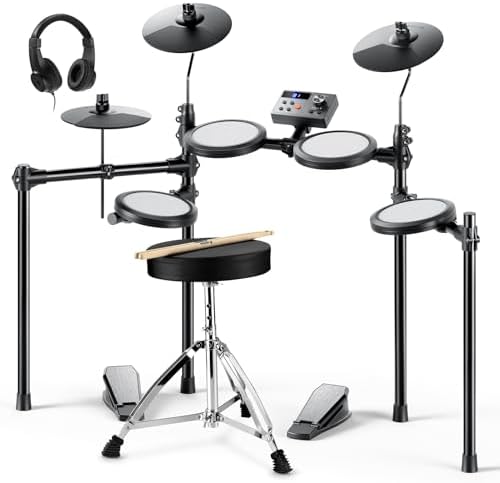
Electronic drum kits usually need 5 count of drum pads for basic practice, lessons, and a compact layout. If you want separate snare, tom, and cymbal pads, 5 count is the floor; below that, the kit starts to lose the layout most beginners expect.
New drummers should see our roundup of beginner-friendly electronic drums to find their first kit.
Recommended Drum Pad Counts by Use Case
| use case | recommended Number of drum pads | why this number |
|---|---|---|
| practice basic stick control and simple grooves on a compact starter kit | at least 5 count | 5 pads give a snare, tom, and cymbal layout without forcing a stripped-down setup. |
| learn rimshots and separate snare articulations for lessons | at least 5 count | Rimshots need a dedicated snare zone, and 5 pads usually preserve that separate playing area. |
| keep a small practice kit manageable in a bedroom corner | 5 count | The median in the listings we screened is 5 count, so that count matches the most common compact layout. |
| fit a kit into a tight apartment practice area | 5 count | Use the smallest layout that still separates snare, tom, and cymbal duties; 5 count is the usual threshold for that. |
| learn on a kit that gives separate snare, tom, and cymbal pads instead of a stripped-down layout | 5 count | That split needs enough pads to assign each role without doubling up one surface. |
| add room for more parts without changing the basic practice footprint | 6 to 8 count | Choose this range when you want extra toms or cymbals after the basic 5-pad layout is already covered. |
Examples from this category, each with its own review here
From $189.04 to $699: 3 of the 15 in this category we have reviewed in full.
If noise is a concern, explore the best electronic drum kit for quiet practice for silent sessions.


What Happens If You Go Under or Overbuy?
Underbuying usually costs you separate playing zones. A 4-pad layout can force the snare, toms, or cymbals to share duties, and that makes lessons less specific when you need rimshots or distinct articulations.
Parents can find a suitable entry point by looking at our top-rated electronic drum kits for kids.
Overbuying costs space and attention. If you move from 5 count to 8 count without a clear use for the extra pads, you pay for more striking surfaces than your practice routine needs, and the kit becomes harder to place in a bedroom or apartment corner.
Beginners can find their start by viewing our guide to the best electronic drum kit for learning drums.
Here is the practical tradeoff: the first extra pad only helps when you already know what role it serves. A 6 to 8 count layout makes sense for added cymbal or tom coverage, but not for a beginner who still plays basic grooves on a single snare, a few toms, and one or two cymbals.
Researching your budget is easy with our breakdown of electronic drum kit costs and features.
The Mistake Most Buyers Make With Pad Count
The mistake most buyers make with drum pad count is chasing a larger number before they know what each pad does. A 7-pad kit is not automatically better than a 5-pad kit if the extra pads do not change the snare, tom, or cymbal roles you need.
Ensure your gear meets standards by reviewing the safety standards for electronic drum kits.
What you should optimize instead is layout clarity. Count only the pads that give you separate work for the snare, toms, and cymbals, because that is what changes practice value for lessons and basic coordination.
Learn about different configurations by viewing the different types of electronic drum kits explained.
For a first kit, the useful question is not how many pads the shell carries. It is whether the count leaves you with a clear snare, enough tom coverage, and enough cymbal separation for the patterns you actually play.
Protect your investment by reading our guide to electronic drum kit warranties before purchasing.
When Other Specs Limit Drum Pad Count Value
Number of drum pads matters less when the kit has a weak snare layout. If the snare is single-zone, extra pads do not restore rimshots or separate snare articulations, so the higher count gives less practical value.
You can see the full specs in our full review of the AED-403.
Pad count also loses value when the kit lacks a hi-hat controller input. Without that input, open and closed hi-hat work stays limited, even if the kit has enough pads for toms and cymbals.
Explore the features in our full review of the Nitro Max.
Rubber pads can also blunt the benefit of a higher count. The category reference points already show why mesh and proper trigger inputs matter more than pad quantity once you want realistic response, because pad count alone does not fix the feel or the articulation set.
View the technical details in our full review of the MED-X3.
Use the count as a layout check, then verify the snare, cymbal input set, and hi-hat control. A 10-pad layout can still be a poor choice if the kit cannot separate the sounds you need, while a 5-pad layout can be enough when those other parts are present.
Check out the performance details in our full review of the MK-0.
More digital drum set explainers and comparisons
- Best Electronic Drum Kit for Learning Drums
- Practicing Bluetooth Drum at Home With an Electronic Drum Kit
- Which Electronic Drum Kit Works for Drum Practice With Headphones?
- The Electronic Drum Kits That Work Best for Beginners
- Which Electronic Drum Kit Is Best for Apartment Practice?
- Best Electronic Drum Kit for Kids
Top Discounts is reader-supported: some links on this page are affiliate links, and as an Amazon Associate Top Discounts earns from qualifying purchases at no extra cost to you. Learn more.