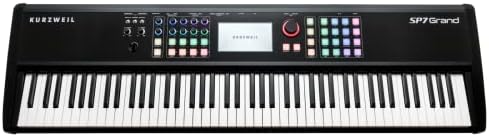
Kurzweil SP7 Grand
SP7 Grand shapes sustain with String Pedal Resonance Modeling, so it suits you if piano expression matters on stage.
88-key key count
- key count
- 88-key
$5,812 over the category median
- This Stage Piano
- $5999
- Median of the 35 Stage Pianos we screened
- $186.76
- Range
- $133.80 to $5999
- Cheaper than this one
- 33 of those 35
3.7/5 from 5 buyers
- Average buyer rating
- 3.7 out of 5
- Ratings behind it
- 5
- What that supports
- Too small a sample to conclude anything either way
- Where it comes from
- The product listing, read 5 November 2026
3 deciding specs not stated
- key action weight
- Not stated in the listing – confirm with the seller before ordering
- onboard speaker power
- Not stated in the listing – confirm with the seller before ordering
- MIDI connectivity
- Not stated in the listing – confirm with the seller before ordering
SP7 Grand Overview
Kurzweil SP7 Grand drives 88 keys for players who need full piano range.
If you play in a setup that needs sustain pedal support and USB audio interface routing, the stage piano choice becomes a system decision, not just a key-count decision.
Kurzweil SP7 Grand states sustain pedals and a USB audio interface, which suits players who want direct computer connection without adding extra hardware. That connectivity is the strongest fit signal in the listing data.
We screened 35 stage pianos, and this is one of 15 chosen for a full review. Full reviews go to the most-rated products that pass screening, with at most 2 per brand. SP7 Grand has 5 buyer ratings, the 11th most of the 35 screened. Its $5,999 price and 3.7 average across 5 ratings are context only; a sample this small settles nothing.
For a more portable alternative, read our Yamaha CP300 spec analysis.
How Top Discounts picked: we started from the 200 most-reviewed stage piano listings in our retail dataset, removed duplicates, accessories and off-category products, and 35 qualified. This product is one of 15 from that pool chosen for a full review. Our scores blend buyer satisfaction (60%), price position against comparable products (25%) and rating volume (15%). Specifications come from manufacturer listings and ratings from verified Amazon buyer reviews (data checked November 2026).
The Short Answer on the SP7 Grand
Best for: you need 88 keys and a fully weighted hammer-action feel for piano parts in a stage setup.
Choose the SP7 Grand if that 88-key layout and Fatar TP100LRG action matter more than a lower entry price; it sits around $5,999.
- Pro: The 88-key layout supports full piano repertoire and two-handed parts.
- Pro: The Fatar TP100LRG fully weighted hammer-action keybed suits players who want acoustic-piano-style resistance.
- Pro: USB audio interface support lets it connect more directly to a computer rig.
- Con: The $5,999 price puts it out of reach for budget-first buyers who only need a basic weighted board.
- Con: Five buyer ratings give a 3.7 average, and that sample is too small to support a quality verdict.
Don’t buy this if: you need a portable 61-key stage piano for tight transport or compact splits.
Price assessment: $5,999 is premium for the spec set, even with 88 keys, weighted action, and USB audio interface support.
Top Discounts score: 4.9/10 (data-driven – see “How we picked” above)
Research finding the best stage piano for studio recording to see our top recommendations.
Full Specifications for the Stage Piano
| Spec | Value |
|---|---|
| Key count | 88-key |
| Pedals | sustain |
| USB audio interface | Yes |
| Key action | Fatar TP100LRG Fully weighted Hammer-action Keybed |
| String Pedal Resonance Modeling | Yes |
| A.T.S.T. Sound Engine | Yes |
| Polyphony | 256-voice |
| Factory presets | 307 |
Key count is the deciding spec that most separates the SP7 Grand. It measures how many keys the stage piano has for playing notes.
Where this sits in the buyer data: Among the 17 products screened for this category, this one’s 3.7 rating places it #16, on 5 ratings – below the 7-rating median of that group, so treat the average as less settled than its comparables. On price it undercuts 0 of them.
What These Specifications Let You Do
What the weighted keybed means for piano parts
Buyers who need weighted piano parts should focus on the Fatar TP100LRG fully weighted hammer-action keybed. An 88-key layout gives you full piano range for two-handed repertoire and split setups, so you are not forced into the narrower reach of a 61-key stage board.
The SP7 Grand’s key count supports standard piano literature, while the weighted action supports acoustic-piano-style phrasing on the keys. Choose it if your left hand needs room for bass lines and chord work at the same time; a shorter board would cost you range and likely force a rebuild of your splits.
What the sound engine does for live parts
The A.T.S.T. Sound Engine gives the SP7 Grand a dedicated piano-and-stage voice source for live parts and layered registrations. That matters if you want one board to cover acoustic-piano parts and additional stage sounds without moving to a separate controller and sound module setup.
Its 307 factory presets give you a large starting library for setlists, rehearsals, and quick patch changes. If you build many sounds from presets rather than from scratch, that count saves time during setup; if you prefer a very small, hand-built palette, the extra factory material is less important.
Why 256-note polyphony matters with sustain
Yes, 256-note polyphony is the figure that matters when you use sustain, layered sounds, and dense chords. Polyphony is the number of notes the instrument can sound at once, so a higher count gives you more room for long-held passages and stacked parts before notes start dropping out.
SP7 Grand’s 256 voices also leave headroom for pedal-heavy playing and layered registrations, which is where lower-polyphony stage pianos can run out of notes first. If you arrange with thick right-hand voicings, sustained left-hand harmony, and a pedal held through phrase changes, this spec reduces the chance that your arrangement has to be simplified.
The SP7 Grand Against Similar Stage Pianos
The SP7 Grand’s clearest edge is its 88-key layout at the same $5,999 price as the Nord Electro 6D 61. Most buyers expect the 61-key model to be the budget route, but the numbers here do not follow that pattern.
- Against the Nord Electro 6D 61, the SP7 Grand gives you 88 keys instead of 61. That extra range matters for two-handed piano parts and wider splits.
- Against the Roland RD-2000, the SP7 Grand has the same 88-key count, but it costs around $2,000 more. If key count is your only deciding factor, the Roland leaves more budget for other gear.
- Against the Nord Electro 6HP, the SP7 Grand also uses 88 keys, while the Nord lists a 73-key hammer-action board. If you want full piano range, the Kurzweil keeps it simple.
- Against the Nord Piano 88, the SP7 Grand matches the 88-key format and adds USB audio interface support, which the comparison set does not state for the Nord. That helps if you want one cable path for computer audio and recording.
- Against the Kawai MP11SE, the SP7 Grand sits at the far higher price point, around $5,999 versus $1,699.99. The Kawai is the leaner buy if your budget matters more than the Kurzweil’s feature set.
If you want the lower-priced alternative, the Kawai MP11SE is the cleaner pick. If you want a cheaper stage piano with the same 88-key count, the Roland RD-2000 is the stronger value call.
If you are looking for a more compact option, see our full review of the SP6.
You might also consider the Yamaha CP88 performance breakdown for a different feel.
Setting Up This Stage Piano, and What Support Covers
Getting the SP7 Grand ready to play
The SP7 Grand needs a stable playing surface before it does anything useful. A keyboard stand and keyboard bench are the other two pieces you need for normal seated use, and the stand must suit an 88-key stage piano.
- Place the SP7 Grand on a keyboard stand sized for an 88-key instrument.
- Set the stand height so the Fatar TP100LRG fully weighted hammer-action keybed sits at a comfortable playing level.
- Connect a sustain pedal, since the listing states pedal support and the piano uses that input for note extension.
- Attach headphones if you need silent practice, because the listing does not state onboard speakers.
- Power up and select one of the 307 factory presets for your first sound.
Warranty and support checks for the SP7 Grand
Cover differs by seller and country.
- Confirm the return window before you keep it, because the SP7 Grand is a $5,999 stage piano with an 88-key weighted action.
- Confirm whether the seller covers the USB audio interface, because that feature is stated and replacement parts may not be simple.
- Confirm whether pedal support is included in the cover, because the sustain function depends on that input.
- Confirm who handles support for the keybed, because the Fatar TP100LRG is the main playing mechanism.
On the day it arrives, power it on and verify the 88 keys, the sustain pedal input, and the USB audio interface while a return is still open.
Stage Piano Buying Questions Answered
Are 307 factory presets enough, or will I end up needing extra sounds right away?
SP7 Grand gives you 307 factory presets, which is a large onboard library for a stage piano. That count should cover a lot of setlist work, but the data does not say how those presets are distributed across pianos, organs, pads, or other sounds.
Is it worth $5999, or am I paying a premium for features I may not use?
At around $5,999, SP7 Grand sits in a high-price bracket, so the value question depends on whether you need its 88-key format, fully weighted hammer-action keybed, and USB audio interface. The price is easier to justify if you want a full-size stage piano with those features; if you do not need them, the cost is harder to defend from the specs alone.
Will the 88-key size and full-weighted action fit my space and still be practical to move?
SP7 Grand uses an 88-key layout with a Fatar TP100LRG fully weighted hammer-action keybed, so it is built for full piano range and weighted playing. That same format is less compact than a 61-key board, and the listing does not state weight or dimensions, so portability cannot be judged from the data here.
Is the SP7 Grand Right for You?
Who the SP7 Grand suits and the jobs it is the wrong choice for, listed below with the reason for each.
Who the SP7 Grand is for, and what it does well
Who this stage piano suits
- Gigging keyboardists — 88 weighted keys and 256-voice polyphony suit layered piano parts and sustained passages on stage
- Piano students practicing on a full-size action — the Fatar TP100LRG hammer-action keybed gives a realistic 88-key practice feel
- Church keyboard players — 307 factory presets and pedal resonance modeling cover piano, pad, and accompaniment sounds for services
- Film and theatre pit musicians — the 88-key layout and high polyphony handle split-second changes and dense arrangements
- Home studio composers writing piano-led cues — the sound engine and 307 presets provide ready-to-play sounds without needing a separate module
What this stage piano handles well
- Live piano performance — 88-key stage piano with fully weighted hammer-action keybed
- Sustained chord voicings and dense layered parts — 256-voice polyphony
- Expressive acoustic-piano-style playing — string pedal resonance modeling
- Quick access to many stage sounds — 307 factory presets
- Rehearsals and service setlists — A.T.S.T. sound engine for immediate playable sounds
What the SP7 Grand is the wrong choice for
- Portable busking setups — 88-key weighted stage piano is large and heavy compared with compact keyboards
- Synth lead and fast organ glissando playing — fully weighted hammer-action keybed is slower and less suited than synth-action keys
- Bedroom practice through headphones without extra gear — the specs do not include built-in speakers
- MIDI controller-only workflows with lots of knobs and sliders — the specs focus on piano action and presets, not deep controller controls
What to budget alongside the SP7 Grand, and what to skip
Accessories worth buying with this stage piano
- Keyboard stand — an 88-key stage piano needs a stable support to be playable
- Sustain pedal — pedal resonance modeling implies you will want a pedal to use the piano-style sustain behavior
- Amplifier or powered speaker — the specs do not include built-in speakers, so you need external sound reinforcement
- Keyboard bench — the full-size 88-key weighted action is meant to be played seated for long sessions
- Protective gig bag or hard case — an 88-key stage piano is a transport instrument that needs protection when moved
Accessories you can skip buying for this stage piano
- Weighted key upgrade — the fully weighted hammer-action keybed is already built in
- Extra sound module — the A.T.S.T. sound engine and 307 factory presets already provide the instrument sounds
- Polyphony expansion — 256-voice polyphony is already specified, so a separate upgrade for more notes is unnecessary
- Piano resonance effect pedal — string pedal resonance modeling is already part of the instrument
Where to Buy This Stage Piano
In November 2026 the SP7 Grand was listed at $5999. Prices move, so read that as a snapshot, not a quote.
Stage pianos are sold by the retailers below – we do not track which of them has the SP7 Grand in stock, so check availability and the current price with the retailer before making a trip.
- Music & Arts (online and physical stores) — local store support and ordering help for keyboard buyers
- B&H Photo Video (online and physical stores) — breadth of range for pro audio and keyboard gear
- Sam Ash (online and physical stores) — specialist music retail experience for stage pianos
- Piano World (online only) — specialist focus on digital pianos and stage pianos
- Amazon (online only) — broad marketplace selection and easy comparison shopping
- Sweetwater (online and physical stores) — specialist staff and a broad range for stage pianos
- Guitar Center (online and physical stores) — in-store returns and a wide selection across major keyboard brands
Final Verdict on the SP7 Grand
If you need an 88-key stage piano with fully weighted action, the SP7 Grand fits that need at around $5,999. The Fatar TP100LRG keybed gives you the full keyboard count that piano parts demand, while the 256-voice polyphony leaves room for layered parts and sustained passages.
What matters most here is the 88-key layout, because that is the figure that keeps two-handed piano writing intact. The 307 factory presets and USB audio interface add flexibility for stage and computer use, but they do not change the core decision as much as the key count does.
Skip it if: you want built-in speakers or a lower-cost stage piano, or if you do not need an 88-key weighted board.
More stage piano explainers and comparisons
Top Discounts is reader-supported: some links on this page are affiliate links, and as an Amazon Associate Top Discounts earns from qualifying purchases at no extra cost to you. Learn more.