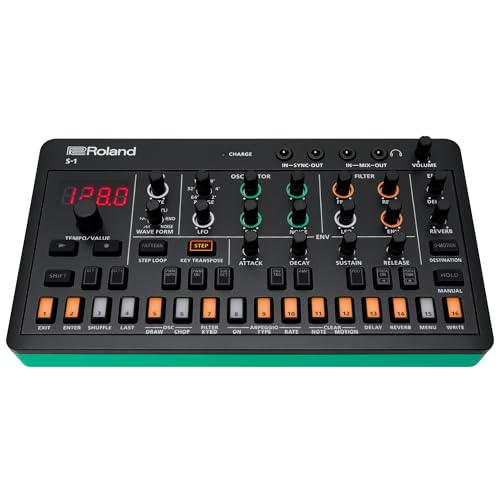
Roland AIRA Compact S-1
S-1 draws four voices with ACB technology, so it suits you if compact synth control matters.
four-voice polyphony voices
- Polyphony voices
- four-voice
4.5/5 from 190 buyers
- Average buyer rating
- 4.5 out of 5
- Ratings behind it
- 190
- What that supports
- A large enough sample to read as a real buyer signal
- Where it comes from
- The product listing, read 5 November 2026
3 deciding specs not stated
- Sequencer steps
- Not stated in the listing – confirm with the seller before ordering
- Keys
- Not stated in the listing – confirm with the seller before ordering
- MIDI DIN ports
- Not stated in the listing – confirm with the seller before ordering
Suits bedroom producers making synth-pop hooks
- Bedroom producers making synth-pop hooks
- Electronic musicians building portable live sets
- Sound design students learning subtractive synthesis
- Keyboard players needing a small second synth
Will the S-1 synthesizer do what you need it for? Tick what applies – 6 things worth checking before you order
This one is $269.99, at or below the $479.50 median of the 84 we screened – it undercuts 65 of them.
The listing does not state its MIDI DIN ports – confirm it before you buy an MIDI cable for it.
The listing does not state it – confirm with the seller before ordering.
The listing does not state it – confirm with the seller before ordering.
The listing does not state it – confirm with the seller before ordering.
The listing says nothing about sound character – ask the seller before you order.
The S-1 in Short
Roland AIRA Compact S-1 S-1 Synthesizer produces four-voice parts for you if you need chords and pads in a compact synth.
Four-voice polyphony keeps the S-1 from being a mono-only dead end when you need chords or sustained pads in a compact synth.
Roland AIRA Compact S-1 uses four-voice polyphony, and that is the number that matters most if you need harmony rather than single-note lines. The S-1 also carries oscillator drawing and oscillator chop, which shape how quickly you can sketch and reshape parts.
We screened 84 Synthesizers and this is one of 15 chosen for a full review. Full reviews go to the most-rated products that pass screening, at most 2 per brand. This one has 190 buyer ratings, the 14th most of the 84 screened. This review is for you if you want a practical synth with chord support and a compact footprint. The price sits around $269.99, and the buyer score is 4.5 from 190 ratings.
Newcomers should check the best synthesizer for beginners under $500 to find a great entry point.
How Top Discounts picked: we started from the 200 most-reviewed synthesizer listings in our retail dataset, removed duplicates, accessories and off-category products, and 84 qualified. This product is one of 15 from that pool chosen for a full review. Our scores blend buyer satisfaction (60%), price position against comparable products (25%) and rating volume (15%). Specifications come from manufacturer listings and ratings from verified Amazon buyer reviews (data checked November 2026).
The Short Answer on the S-1
Best for: you want a compact synth with four-voice polyphony, hands-on controls, and SH-101-style sequencing tools for direct pattern work.
S-1 is a practical buy at around $269.99 if you need chord work, unison stacking, and a small desktop footprint.
- Pro: Four-voice polyphony lets you play sustained chords instead of forcing everything into monophonic lines.
- Pro: Mono, poly, unison, and chord modes give you several performance setups from one panel.
- Pro: The 10.25 x 6.6 x 3.5 inch size suits a tight desk or portable rig.
- Con: Four voices limit dense harmony, so stacked pads and wider voicings run out of notes faster than on larger polysynths.
- Con: The spec list does not state MIDI DIN or USB-MIDI, so this is a poor fit if your setup depends on those connections for clock or computer control.
Don’t buy this if: you need a synth with at least 16 sequencer steps for longer pattern building.
Price assessment: $269.99 is fair for four-voice polyphony, the hands-on panel, and the included mode set.
Top Discounts score: 8.5/10 (data-driven – see “How we picked” above)
Key Specifications
| Spec name | Value |
|---|---|
| Polyphony voices | four-voice |
| Keys | Not stated |
| Oscillator | Square oscillator |
| Oscillator | Sawtooth oscillator |
| Oscillator | Sub oscillator |
| Oscillator | Noise oscillator |
| Modes | Mono mode |
| Modes | Poly mode |
| Modes | Unison mode |
| Modes | Chord mode |
Polyphony voices most separates the S-1 here. It measures how many notes the synth can sound at the same time.
Where this sits in the buyer data: Among the 84 products screened for this category, this one’s 4.5 rating places it #36, on 190 ratings – above the 46-rating median of that group, so the average rests on more feedback than most of its comparables. On price it undercuts 65 of them.
What the Numbers Mean in Use
How Four-Voice Polyphony Supports Chords and Pads
The S-1 can play chords, and its four-voice polyphony gives you enough notes for compact chord parts and pads. That matters if you write stacked harmonies, because four voices cover simple triads with room for added tones or doubled notes, while monophonic synths cannot do that at all. The mono, poly, unison, and chord modes also give you different note-count behaviors for lead lines, harmony parts, and thicker single-note sounds.
If you need sustained voicings with more than four notes, the S-1 will force you to voice them carefully or split them across parts. For a player who wants chord stabs, short progressions, or simple pads, that limit is workable; for dense piano-style voicings, it is not. If you are arranging for chords, count the notes in your parts first, then decide whether four voices cover the job or whether you need a synth with more headroom.
How Oscillator Tools Shape Bass, Leads, and Transitions
The S-1 gives you square, sawtooth, sub, and noise oscillators, so you can build basses, leads, and texture layers without relying on outside sources. The oscillator drawing, oscillator chop, and riser tools add movement-focused sound design options, which suits you if you need quick transitions, sweeps, or percussive timbres from one synth. That mix is useful for practical writing because it covers both steady parts and effect-like gestures from the same instrument.
The sub oscillator is the part that changes the low end most directly, while noise is the one that adds non-pitched texture for attacks and transitions. Because the S-1 is a micro polysynth, those tools favor compact arrangements and layered parts more than huge multi-part rigs. If you want one synth to cover bass, lead, and sound-effect duties, these oscillator options give you that range without changing instruments.
How Hands-On Controls Speed Up Sound Changes
The hands-on panel means you can reach for sound changes quickly instead of working through menus. That is the practical value here: direct controls suit you when you want to shape a part while writing, rather than stopping to navigate deeper pages. The panel layout also fits the S-1’s compact size, which keeps the instrument set up for fast edits on a desk or in a small rig.
The trade-off is that the panel gives you speed, not a full-size control surface, so the S-1 suits immediate tweaks more than sprawling performance setups. Its 10.25 x 6.6 x 3.5 inch footprint keeps it small enough for tight spaces, but that same size means fewer physical controls than a larger synth. If your own setup has limited desk space, measure the area you can spare; if it is tight, the S-1 fits that constraint better than a larger panel would.
How the S-1 Compares to Alternatives
The S-1’s clearest edge is four-voice polyphony in a 10.25 x 6.6 x 3.5 inch body. That gives you chord work and compact placement without giving up a hands-on panel or the SH-101-inspired layout.
- Against the J-6, the S-1 gives you a synth engine with mono, poly, unison, and chord modes. The J-6 is a chord sequencer with JUNO-60 tones, so it serves a different job.
- Against the Liven 8bit Warps, the S-1 is $10.99 more expensive. That extra cost buys four-voice polyphony instead of a 128-step sequencer and 4-track looper.
- Against the Edge, the S-1 is a keyboard synth with a hands-on panel, while the Edge is a semi-modular percussion unit with a 15 x 10 I/O patch matrix. They are built for different kinds of control.
- Against the Volca Nubass, the S-1 is the only one here that states four-voice polyphony. The Nubass centers on Nutube technology, a transistor ladder filter, and a 16-step sequencer instead.
- Against the PRO-800, the S-1 loses on voice count. The PRO-800 lists 8-voice polyphony, so it is the better pick if you need more notes sounding together.
If you need more than four simultaneous notes, pick the PRO-800 instead. Its 8-voice polyphony is the direct answer for denser chords and layered parts.
If you are looking for a different sound palette, read our full review of the J-6.
For those interested in unique wavetable synthesis, see how the Arturia MicroFreak performs.
Getting This Synthesizer Working, and What to Check After
Getting the S-1 ready to play
The S-1 needs a power source before it does anything useful.
- Unpack the S-1 and set it on a surface that leaves room for its 10.25 x 6.6 x 3.5 inch footprint.
- Connect the power adapter to the unit, matching the power input it requires; that figure is not stated here.
- Choose a play mode on the panel: mono, poly, unison, or chord.
- Select a sound source from the square oscillator, sawtooth oscillator, sub oscillator, and noise oscillator options.
- Use the hands-on panel to shape the sound, then save your setup if your workflow depends on recall.
Warranty and support checks for this synth
Warranty cover differs by seller and country.
- Confirm the return window before it closes, because the S-1 has four-voice polyphony and may not suit chord work if you need more notes at once.
- Confirm the power adapter requirement, because the listing does not state the operating power figure here.
- Confirm MIDI cable compatibility, because the MIDI DIN port count is not stated in this listing.
- Confirm USB cable compatibility, because the USB-MIDI detail is not stated here.
On the day it arrives, power up the S-1 and verify that the adapter, panel controls, and mode buttons all respond while a return is still possible.
What Buyers Still Want to Know About This Synthesizer
Will the Roland AIRA Compact S-1 feel cramped on a desk or in a travel setup?
Yes, the S-1 is compact enough for a desk or travel setup, with dimensions of 10.25 x 6.6 x 3.5 inches. That footprint suits a portable rig, and the four-voice polyphony still gives you chord and pad options without needing a larger keyboard.
How much playing range does the S-1 give you for chords and layers?
The S-1 gives you four-voice polyphony, so it can sound four notes at once. That matters if you need chords, small pads, or stacked parts from a compact synth. It will not cover larger voicings that need more simultaneous notes.
Does the S-1 work as a simple hands-on synth for quick sound changes?
The S-1 has a hands-on panel, plus oscillator drawing, oscillator chop, and riser tools. Those controls point to fast sound shaping without menu-heavy work. Its mono, poly, unison, and chord modes also give you direct performance choices from the panel.
Is the S-1 a good purchase if I want SH-101-style sound in a small synth?
The S-1 is a fit if you want an SH-101-inspired synth in a compact format. It uses Roland Analog Circuit Behavior technology and includes square, sawtooth, sub, and noise oscillators. Around $269.99 puts it in a reachable range for a small hardware synth with those controls.
Does the S-1 make sense for buyers who want a portable synth with buyer feedback behind it?
Yes, the S-1 has a 4.5 average from 190 buyer ratings, so you have a sizable feedback sample to read alongside the specs. That rating is context, not a reason by itself. The useful part here is the compact size and four-voice design, which suit a portable setup.
Is the S-1 Right for You?
Who the S-1 suits and the jobs it is the wrong choice for, listed below with the reason for each.
Who this synth is for, and what it does well
Who the S-1 suits
- Bedroom producers making synth-pop hooks — four-voice polyphony, chord mode, and hands-on controls make it easy to sketch melodies and harmonies in a small setup
- Electronic musicians building portable live sets — the compact 10.25 x 6.6 x 3.5 inch size and performance tools like oscillator chop and riser tools suit quick on-the-go use
- Sound design students learning subtractive synthesis — square, sawtooth, sub, and noise oscillators plus ACB modeling make it useful for studying classic synth architecture
- Keyboard players needing a small second synth — mono, poly, unison, and chord modes give multiple playing styles in one tiny instrument
- Makers of retro-inspired techno and electro — the SH-101 inspiration and four-voice polyphony fit basslines, riffs, and simple chord stabs
- Apartment musicians with limited desk space — the micro form factor and hands-on panel suit a compact home studio without much room
What this synthesizer handles well
- Writing synth-pop chord stabs — four-voice polyphony and chord mode
- Programming basslines — mono mode and sub oscillator
- Creating lead synth riffs — square oscillator, sawtooth oscillator, and hands-on panel
- Making risers and transition effects — riser tools and oscillator chop
- Learning classic analog-style synthesis — Roland Analog Circuit Behavior technology and SH-101-inspired design
- Portable jam sessions — compact dimensions and multiple play modes
What this synthesizer is the wrong choice for
- Playing full piano-style arrangements — four-voice polyphony limits dense chords and layered voicings
- Deep multitimbral sequencing setups — it is a single compact synth with no spec for multiple independent parts
- Sampling and sample playback work — the listed specs are oscillator-based synthesis only, not sample loading
- Large stage keyboard replacement — the 10.25 x 6.6 x 3.5 inch body is too small for a full performance keyboard role
What to budget alongside this synth, and what to skip
Accessories worth buying with the S-1
- Audio cable — needed to connect the synth’s output to speakers, an audio interface, or a mixer
- Power source or USB power supply — needed to run a compact synth that is not specified as battery-powered
- Headphones or monitor speakers — needed to actually hear the four-voice synth output
- MIDI cable or USB MIDI connection — needed if you want to control it from other gear or sequence it externally
- Protective case or sleeve — needed to carry and store a small hands-on instrument safely
Accessories you can skip buying for this synth
- Full-size keyboard stand — the 10.25 x 6.6 x 3.5 inch format is meant for tabletop use, not a large stand
- Extra oscillator modules — the synth already includes square, sawtooth, sub, and noise oscillators
- Polyphony expansion hardware — the instrument is fixed at four-voice polyphony
- External analog modeling box — Roland Analog Circuit Behavior is already built in
You might also enjoy exploring the specs of the Behringer MODEL D.
Where to Buy This Synth
The S-1 sat at $269.99 in the listing data from November 2026; the price you see at checkout can differ.
Synthesizers are sold by the retailers below – we do not track which of them has the S-1 in stock, so check availability and the current price with the retailer before making a trip.
- Guitar Center (online and physical stores) — in-store returns and used or open-box stock
- B&H Photo Video (online and physical stores) — breadth of range for pro audio and music production gear
- Musician’s Friend (online only) — broad catalog and frequent comparison shopping for music instruments
- Amazon (online only) — broad marketplace selection from multiple sellers
- Sam Ash (online and physical stores) — music-instrument specialist retail and trade-in options
- Thomann (online only) — breadth of range and cross-border selection for niche synths
- Sweetwater (online and physical stores) — specialist staff and a broad range of music gear
To see how different models stack up, view the best synthesizer for making electronic music.
Final Verdict on the S-1
You should choose the S-1 if you want a compact synthesizer with four voices, hands-on controls, and a price around $269.99. That voice count lets you play chords and pads, while mono, poly, unison, and chord modes give you different ways to shape a part without leaving the panel.
The strongest figure here is the four-voice polyphony. That is the number that decides whether chords are available at all, and it keeps the S-1 in the role of a compact part-writing synth rather than a single-note lead machine. Like a four-seat bench, it sets the limit on how many notes can sit together.
Skip it if: you need more than four notes at once, or you need a larger keyboard for two-handed playing.
Top Discounts is reader-supported: some links on this page are affiliate links, and as an Amazon Associate Top Discounts earns from qualifying purchases at no extra cost to you. Learn more.