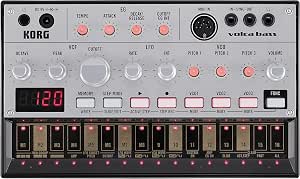
Korg VOLCABASS
VOLCABASS shapes bass lines with three analogue oscillators, so it suits you if compact synth bass is the goal.
16-step sequencer sequencer steps
- Sequencer steps
- 16-step sequencer – at or above the 16-step sequencer reference figure
4.6/5 from 307 buyers
- Average buyer rating
- 4.6 out of 5
- Ratings behind it
- 307
- What that supports
- A large enough sample to read as a real buyer signal
- Where it comes from
- The product listing, read 5 November 2026
3 deciding specs not stated
- Polyphony voices
- Not stated in the listing – confirm with the seller before ordering
- Keys
- Not stated in the listing – confirm with the seller before ordering
- MIDI DIN ports
- Not stated in the listing – confirm with the seller before ordering
Suits bedroom producers making basslines at home
- Bedroom producers making basslines at home
- Electronic music students learning subtractive synthesis
- Apartment dwellers with limited space
- Beatmakers building short bass patterns
VOLCABASS Overview
VOLCABASS Synthesizer drives a 16-step sequencer for you if you want hands-on bass patterns and short loops.
If you move a synth around a lot, optional battery power changes where you can place it and whether a wall socket decides the session.
VOLCABASS Synthesizer fits that situation because it states optional battery power, built-in speaker support, and Sync In and Out. Its low-pass filter with resonance gives the sound-shaping control that matters after the power choice is settled.
We screened 84 synthesizers and this is one of 15 chosen for a full review. Full reviews go to the most-rated products that pass screening, at most 2 per brand. VOLCABASS has 307 buyer ratings, the 10th most of the 84 screened. This review is for you if you care more about portable use than about a fixed studio setup.
You might also consider looking at the Korg Nu:Tekt NTS-1 MKII analysis.
How Top Discounts picked: we started from the 200 most-reviewed synthesizer listings in our retail dataset, removed duplicates, accessories and off-category products, and 84 qualified. This product is one of 15 from that pool chosen for a full review. Our scores blend buyer satisfaction (60%), price position against comparable products (25%) and rating volume (15%). Specifications come from manufacturer listings and ratings from verified Amazon buyer reviews (data checked November 2026).
The Short Answer on the VOLCABASS
Best for: you want a battery-powered synth with a 16-step sequencer for short bass lines and live pattern changes.
VOLCABASS is a sensible pick at around $149.10 if you want hands-on bass sequencing without a computer.
- Pro: The 16-step sequencer supports short riffs and simple live loops with no external gear.
- Pro: Three analogue oscillators give you more layering options than a single-oscillator bass synth.
- Pro: Sync In and Out let it fit into hardware setups that need clocked timing.
- Con: Eight memory patches limit how many sounds you can store, so frequent sound switching needs more manual setup.
- Con: Built-in speaker output is stated, but it will not replace a larger monitoring setup for fuller playback.
Don’t buy this if: you need more than 16 sequencer steps for longer patterns or evolving sequences.
Price assessment: $149.10 is fair for a compact synth with battery power, sync I/O, and a built-in speaker.
Top Discounts score: 9/10 (data-driven – see “How we picked” above)
Many users find it helpful to see how to choose the best analog synthesizer.
Full Specifications for the Built-In Sequencer and Oscillators
| Spec | Value |
|---|---|
| Sequencer steps | 16-step sequencer |
| Keys | Not stated |
| Power supply | battery power |
| Built-in speaker | Yes |
| Oscillators | Three analogue oscillators |
| Filter | Low-pass filter with resonance |
| Memory patches | Eight |
| Sync | Sync In and Out |
Sequencer steps is the deciding spec that separates VOLCABASS most clearly. It measures how many positions the built-in pattern sequencer can hold.
Where this sits in the buyer data: Among the 84 products screened for this category, this one’s 4.6 rating places it #20, on 307 ratings – above the 46-rating median of that group, so the average rests on more feedback than most of its comparables. On price it undercuts 77 of them.
What These Specifications Let You Do
How Three Analogue Oscillators Shape Bass Lines
VOLCABASS gives you three analogue oscillators, so you can build a bass line with layered pitch movement instead of a single tone. That matters most when you want one part to carry the low end and still leave room for variation across a pattern.
The three-oscillator layout also gives you more room for stacked bass sounds than a single-oscillator synth. If you are programming a simple line for a verse and a thicker variant for a chorus, the extra oscillators give you that split without changing instruments.
How the Low-Pass Filter with Resonance Shapes Bass
The low-pass filter with resonance lets you shape the upper edge of a bass sound and give it more focused movement. For an upgrader coming from a simpler older synth, that means you can trim brightness and keep the part in the low register without relying on external processing.
Resonance adds another contour to the same filter, which helps when you want a line to stand out inside a busy mix. The trade-off is straightforward: more emphasis at the cutoff gives you more character, but it also makes the sound less plain and less neutral.
How the 16-Step Sequencer and Eight Memory Patches Help
The 16-step sequencer is enough for full bass patterns, so you are not forced into tiny loops for hand-built riffs. That length also supports short live parts that repeat cleanly, including a one-bar pattern with room for variation across the steps.
Eight memory patches give you stored sounds for quick recall, and Sync In and Out let VOLCABASS sit in a hardware setup with other gear. If you are building a compact live set, the built-in speaker and optional battery power make it easier to keep the unit self-contained, and the speaker is especially useful for a sketch like a late-night 16-step bass loop without a separate monitor.
The VOLCABASS Job by Job: What Its Figures Cover
The VOLCABASS against the jobs buyers ask about, worked out from its listed sequencer steps and a typical need for each job.
| Job | What it takes | VOLCABASS |
|---|---|---|
| Build 16-step bass riffs and short patterns by hand | at least 16 steps | Yes – 16 steps |
| Make FM-style digital textures for electronic production | at least 16 steps | Yes – 16 steps |
| Run a simple live set with hands-on pattern changes and no computer | at least 16 steps | Yes – 16 steps |
| Program a short live loop that repeats without external gear | at least 8 to 16 steps | Yes – 16 steps |
You can also explore the best digital synthesizer options for buyers.
The VOLCABASS Against Similar Synthesizers
Korg VOLCABASS gives you a 16-step sequencer, eight memory patches, and Sync In and Out for hands-on pattern work. The built-in speaker and optional battery power also make it easier to move between rooms without adding extra gear.
- Against the Behringer TD-3-BK, VOLCABASS has a built-in speaker and optional battery power, while the TD-3-BK listing does not state either feature.
- Against the Korg Volca FM, both synths state 16-step sequencers, so the deciding difference is voice count: Volca FM lists 3-voice polyphony, while VOLCABASS is not stated as polyphonic.
- Against the Electro-Harmonix Bass Micro Synthesizer, VOLCABASS is the more compact sequencing choice.
- Against the Korg Volca Kick/Bass, VOLCABASS adds eight memory patches.
- Against the Donner B1, VOLCABASS has the stronger control standard for hardware setups. It states Sync In and Out, while the Donner B1 listing does not state MIDI DIN or USB-MIDI.
What the deciding spec costs here: Measured as price per unit of Sequencer steps, the reviewed product works out to $9.32 against a $13.27 median across the 25 other screened products that state the spec, and 8 of them deliver more of it per dollar. The cheapest screened product that beats its 16-step sequencer is the SONICWARE LVN-010 at $259 with 128-step, so more of the spec that decides this category starts $109.90 above this one.
If you prefer a different sound engine, see our full review of the Korg monologue.
For a different portable option, you can view the Roland AIRA Compact J-6 review.
Setting Up This Synth, and What Support Covers
Getting VOLCABASS ready to play
VOLCABASS needs a power source before it does anything useful; the listing states optional battery power, and it also states built-in speaker output for self-contained use.
- Insert batteries if you want portable power, since the listing states optional battery power.
- Place VOLCABASS where the built-in speaker can project clearly, because no external monitor is stated.
- Set up a sync connection if you plan to link it to other gear, using the Sync In and Out ports.
- Load one of the eight memory patches, then choose a pattern length that uses the 16-step sequencer.
- Check whether your setup needs a MIDI cable or USB cable, because this listing does not state MIDI DIN ports or USB-MIDI.
Warranty and support details to verify
Cover differs by seller and country.
- Confirm the return window, because the built-in speaker and sequencer are the features you will want to verify first on arrival.
- Confirm whether the seller includes a power adapter, because the listing only states optional battery power.
- Confirm whether your setup needs a MIDI cable, because the listing does not state MIDI DIN ports.
- Confirm whether your setup needs a USB cable, because the listing does not state USB-MIDI.
On the day it arrives, power up VOLCABASS and confirm the built-in speaker, Sync In and Out, and one memory patch before the return window closes.
Synthesizer Buying Questions Answered
Can I use VOLCABASS as a standalone bass synth without needing a computer or keyboard controller?
Yes, VOLCABASS works as a standalone bass synth because it has battery power, a built-in speaker, and Sync In and Out. The 16-step sequencer also lets you build short bass patterns without a computer, and the eight memory patches give you a small set of saved sounds to cycle through.
Is eight memory patches enough, or will I run out of saved sounds right away?
Eight memory patches is a small library, not a broad one. VOLCABASS suits you if you want a few bass sounds ready to recall quickly, but it will feel limited if you switch sounds often during a set.
Is it worth $149.10 for what it does, or am I paying for a toy-level bass box?
At around $149.10, VOLCABASS offers three analogue oscillators, a low-pass filter with resonance, and a 16-step sequencer. That combination gives you real hardware control for bass lines and short patterns, not just a simple preset box.
How many steps does the VOLCABASS sequencer have?
VOLCABASS has an Electribe-style 16-step sequencer. That matters because 16 steps is enough for short riffs, repeating bass figures, and simple live pattern changes. It also keeps the pattern length fixed, so you should expect compact ideas rather than long compositions.
Does the VOLCABASS have a built-in speaker?
Yes, VOLCABASS states a built-in speaker. That helps in a hardware-only setup because you can hear the synth without adding external monitors right away. The listing does not state the speaker’s output level, so plan on treating it as a convenience feature rather than a full monitoring solution.
Is the VOLCABASS Right for You?
Who the VOLCABASS suits and the jobs it is the wrong choice for, listed below with the reason for each.
Who this synth is for, and what it does well
Who the VOLCABASS suits
- Bedroom producers making basslines at home — the built-in speaker, optional battery power, and 16-step sequencer make it easy to sketch ideas without a full studio setup
- Electronic music students learning subtractive synthesis — three analogue oscillators and a low-pass filter with resonance make it a clear hands-on tool for understanding core synth basics
- Live loop performers needing a simple bass source — Sync In and Out plus the step sequencer make it easy to lock patterns to other gear in a small setup
- Apartment dwellers with limited space — the compact format, built-in speaker, and battery option suit someone who cannot keep a full keyboard rig set up all the time
- Beatmakers building short bass patterns — eight memory patches and the Electribe-style 16-step sequencer suit quick pattern writing and recall
- Casual synth hobbyists on a low budget — the low price, simple patch memory, and self-contained speaker make it approachable for experimenting with analog bass sounds
What this synthesizer handles well
- Writing simple bass riffs — the Electribe-style 16-step sequencer
- Making quick techno or house bass patterns — three analogue oscillators and a low-pass filter with resonance
- Practicing synth programming basics — three analogue oscillators and a low-pass filter with resonance
- Syncing with drum machines or other sequenced gear — Sync In and Out
- Saving a few go-to sounds for fast recall — eight memory patches
- Playing ideas without an external amp — built-in speaker
What this synthesizer is the wrong choice for
- Full keyboard bass performance — no full-size keyboard is specified, so it is not suited to playing bass parts like a standard keyboard instrument
- Large sound libraries for many songs — only eight memory patches limits how many sounds can be stored
- Complex multi-track sequencing — the 16-step sequencer is too short for long arrangements and detailed song building
- High-fidelity studio monitoring — the built-in speaker is for convenience, not accurate monitoring
- Portable all-day use without accessories — optional battery power means batteries are not guaranteed to be included
What to budget alongside this synth, and what to skip
Accessories worth buying with the VOLCABASS
- Audio cable — needed to connect the synth’s output to speakers, an audio interface, or a mixer
- Power supply or batteries — needed because power is optional and may not be included
- Headphones — useful for silent practice since the built-in speaker is only for basic monitoring
- External speaker or monitor system — needed for louder playback beyond the built-in speaker
- MIDI or sync cables — needed to use the Sync In and Out connections with other gear
Accessories you can skip buying for this synth
- External sound module — unnecessary because it already has three analogue oscillators and a filter for making its own bass sounds
- Large patch memory card — unnecessary because the unit only supports eight memory patches, so expandable storage is not part of the design
- Full-size keyboard stand — unnecessary if you are using it as a compact desktop synth with its built-in speaker and battery option
Budget-conscious musicians should see the best synthesizer for live performance under $500.
Where to Buy This Synth
The VOLCABASS sat at $149.10 in the listing data from November 2026; the price you see at checkout can differ.
Synthesizers are sold by the retailers below – we do not track which of them has the VOLCABASS in stock, so check availability and the current price with the retailer before making a trip.
- Guitar Center (online and physical stores) — in-store returns and used or open-box stock
- B&H Photo Video (online and physical stores) — breadth of range for pro audio and music production gear
- Musician’s Friend (online only) — broad catalog and frequent comparison shopping for music instruments
- Amazon (online only) — broad marketplace selection from multiple sellers
- Sam Ash (online and physical stores) — music-instrument specialist retail and trade-in options
- Thomann (online only) — breadth of range and cross-border selection for niche synths
- Sweetwater (online and physical stores) — specialist staff and a broad range of music gear
Final Verdict on the VOLCABASS
If you want a compact synth with 16-step pattern writing, built-in speaker playback, and battery power, the VOLCABASS fits that need at around $149.10.
Its strongest number is the 16-step sequencer, which gives you enough pattern length for short bass riffs and simple live loops without external gear.
Skip it if: you need more than eight memory patches, or you want MIDI DIN or USB-MIDI for computer or hardware integration.
The other synthesizer guides we have published
Top Discounts is reader-supported: some links on this page are affiliate links, and as an Amazon Associate Top Discounts earns from qualifying purchases at no extra cost to you. Learn more.