Electronic drum kit terms split into load-bearing specs and sales copy. Snare pad size, pad count, cymbal count, sound library size, MIDI output, and trigger inputs change what you can play and connect. Ignore words that do not state a value, a standard, or a part count.
If you are working with limited floor area, see our guide on finding the best electronic drum kit for small spaces.
Electronic Drum Kit Core Specs That Change Use
Snare pad size, pad count, cymbal count, and sound library size decide how much of the kit you can play and how much variety it offers. If you are choosing on a budget, start with the size and count that match your playing goals, then check the sounds.
Producers looking for high-fidelity output should view our top picks for the best electronic drum kit for recording.
New players can start their journey by viewing our guide to the best electronic drum kit for learning drums.
- Snare pad size – This is the snare playing surface, usually given in inches. A larger number usually helps if you want a more realistic stick target and more room for rim-zone control; a smaller number saves space and usually costs less.
- Number of drum pads – This is the count of separate pads you can strike.
- Number of cymbals – This is the count of separate cymbal pads or cymbal pieces. More cymbals usually give you more crash, ride, and hi-hat options; fewer cymbals usually mean a tighter layout and less cost.
- Sound library size – This is the number of built-in sounds, voices, or presets. A bigger number usually matters if you want more kit styles and practice variety; a smaller number is fine if you only need a basic set of drum voices.
Where these choices show up in our reviews
Each of the 3 shown here has its own full review on this site; they run from $179.89 to $399.99.
You can also explore options for wireless bluetooth drum practice at home to increase your mobility.


Electronic Drum Kit Connections and Standards
MIDI output and trigger inputs decide what the kit can talk to and what pads it can accept. The wrong port type can block expansion, so you need to match the standard before you buy extra gear.
Beginners can find the right starting point by viewing our list of the best electronic drum kit for beginners.
For those living in shared housing, we have a guide on picking the best electronic drum kit for apartment practice.
- 5-pin DIN MIDI – This is the legacy hardware standard for connecting modules and external gear. It matters if your setup uses older MIDI equipment; choosing it over USB changes which devices you can connect without adapters.
- 1/4-inch TRS trigger inputs – This is the common pad-cable format used for most electronic drum triggers. A kit with these inputs can accept many standard pad and cymbal leads; if the input format differs, your trigger cable may not fit or work.
- USB MIDI – This sends MIDI data over USB to a computer, tablet, or compatible module. A higher-compatibility USB setup usually helps if you want recording or software drums, while a missing USB MIDI output limits those routes.
- MIDI output – This is the port or data path that sends note messages to another device. More output options usually give you more routing choices, but the useful standard is the one your external gear accepts.
Electronic Drum Kit Playing Parts You Need to Match
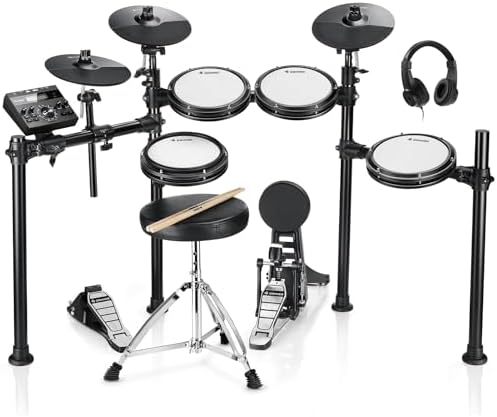
The drum module, hi-hat pedal, kick pedal, drum throne, headphones, and drum sticks are the parts that shape how the kit works for you. Some are included in listings, and some are separate purchases that must match the kit’s inputs or your own body size.
Parents looking for a first instrument can view our recommendations for the best electronic drum kit for kids.
- Drum module – This is the control center for sounds and settings. A module with more sound editing and more outputs usually gives you more control, while a basic module is easier to learn.
- Hi-hat pedal – This controls open and closed hi-hat articulation. If you want convincing hi-hat work, you need a kit with a hi-hat controller input and a pedal that matches it.
- Kick pedal – This triggers the bass drum sound. A pedal that matches the kick pad or trigger input matters more than brand names, because the connection and mounting style have to fit.
- Drum throne – This supports proper playing posture. Seat height matters more than extra padding, so a throne that adjusts to your leg angle is the safer choice.
- Headphones – These let you practice quietly. You need a set that works with the module’s headphone output and sits comfortably for long sessions; impedance is less important than a clean, usable connection here.
- Drum sticks – These are the primary striking tool. Match the stick length and tip style to your comfort and to the pad surface, because a heavier stick changes rebound and control.
Electronic Drum Kit Terms Buyers Often Confuse
Snare pad size and number of drum pads are not the same thing. Snare pad size tells you how wide one playing surface is, while pad count tells you how many separate strike targets the kit includes.
To understand the different hardware configurations available, see the various types of electronic drum kits, explained.
If you aren’t ready for a full kit, explore different electronic drum kit alternatives and similar results.
Sound library size and MIDI output answer different questions. Sound library size tells you how many built-in voices the module holds, while MIDI output tells you whether the kit can send note data to another device.
Ensure your gear meets industry standards by reviewing the certifications and safety standards for electronic drum kits.
Hi-hat pedal and hi-hat controller input also get mixed up. The pedal is the physical part you press, and the controller input is the socket or signal path the module needs to read that motion.
Budgeting is easier when you see what electronic drum kits cost at every price level.
For a deeper dive into the hardware, see our full review of the EDS750.
Drum module and drum throne are easy to confuse because both are central to a setup. The module shapes sound and settings, while the throne only supports your seating position.
You can find more technical details in our full review of the Debut Kit.
Browse our other digital drum set pages
Top Discounts is reader-supported: some links on this page are affiliate links, and as an Amazon Associate Top Discounts earns from qualifying purchases at no extra cost to you. Learn more.