12 string guitars usually land in the middle two price bands, where the median sits at $237.99 or $259.99. As price rises, the main change is specification density: more instruments add onboard electronics, better materials, or both.
12 String Guitar Price Levels at a Glance
| Price level | Price range | Products | Median rating |
|---|---|---|---|
| Entry level | $119.99 to $194.45 | 7 | 4.3 |
| Lower mid-range | $194.45 to $259.99 | 7 | 4.5 |
| Upper mid-range | $259.99 to $299.99 | 7 | 4.6 |
| Top end | $369.99 to $669.99 | 7 | 4.4 |
Products in this category with a full review here
From $194.45 to $237.99: 3 of the 15 in this category we have reviewed in full.


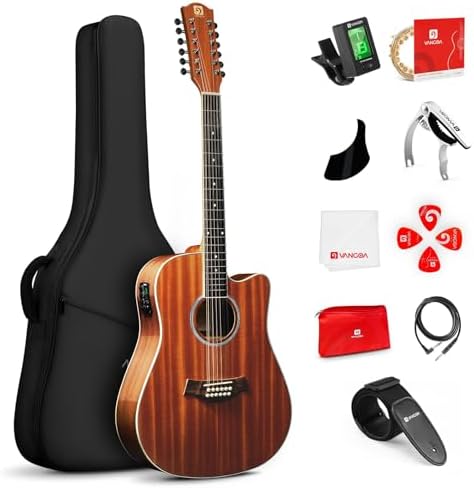
What entry-level 12 string guitars get you
Entry-level 12 string guitars run from $119.99 to $194.45, with a median price of $188.99 and a median buyer rating of 4.3. This range suits you if you want the lowest buy-in and can live with fewer extras.
If your primary focus is rhythm, see the best 12 string guitar for strumming songs.
At this level, the usual tradeoff is feature count, not the basic 12-string format. If your first decision is whether you want a 12 string guitar at all, this band keeps the spend lowest while still covering the doubled-course setup that defines the category.
A living-room songwriter who wants to layer open chords over a vocal track can start here if the goal is simple acoustic use. If you want onboard electronics for plugging in, this tier often gives that up against the next level up.
What lower mid-range 12 string guitars add
Lower mid-range 12 string guitars run from $194.45 to $259.99, and their median price is $237.99. The median rating is 4.5, which sits alongside a broader move toward more complete spec sets.
Left-handed players can explore our guide to finding a left handed 12 string guitar.
This level suits you if you want a safer middle-ground budget and expect to keep the instrument for regular use. The step up usually buys a more rounded feature mix than entry level, especially when the listing includes electronics or a fuller material spec.
If you are choosing between this band and the one above it, check whether you need amplified output. A 12 string guitar with onboard electronics matters more than a small price gap if you plan to play through an amp or PA.
The usual mistake here is paying for the middle band without checking whether the added features matter to your setup. If you will only ever play unplugged, the extra spend can buy specs you do not use.
It is also important to understand how to choose your scale length to ensure comfortable playability.
What upper mid-range 12 string guitars change
Upper mid-range 12 string guitars sit from $259.99 to $299.99, with a median price of $259.99 and a median buyer rating of 4.6. This is the narrowest band, so the price spread is small and the spec differences do more of the work.
This level suits you if you want a tighter budget ceiling but do not want the category’s lowest feature set. The listings in this band are where the balance often shifts toward better materials, more complete electronics, or both.
Make sure to research the best 12 string tuning formats before making your final purchase.
A player who wants one instrument for home practice and small amplified sets has a clearer reason to look here than in entry level. What you give up against the next tier is the chance of a broader feature jump, because the upper band can add more room for higher-cost materials and hardware.
What top-end 12 string guitars add
Top-end 12 string guitars run from $369.99 to $669.99, with a median of $379.99 and a median buyer rating of 4.4. This band is the widest by price, so the spread is about range and feature mix rather than one fixed formula.
This level suits you if you want the strongest specification package and can pay for it. The extra cost often goes into more elaborate construction, better electronics, or both, not into a different string count.
Newcomers should start by learning how a 12 string guitar works and its unique construction.
If you need a stage-ready acoustic-electric setup, this is the band where the added spend is most likely to buy it. What it gives up against the next level up does not apply here, because this is the highest price group on the page.
Where paying more stops buying more
Paying more stops buying more once the price jump no longer changes the deciding specification you care about. On this page, the medians move from $188.99 to $237.99 to $259.99, then to $379.99, but the useful gain depends on whether you need electronics, better materials, or simply a lower spend.
The price-per-unit idea here is the price per deciding specification, not a literal hardware count. For a 12 string guitar, that deciding specification is usually the feature set tied to the instrument’s build and electronics, because the string count stays the same across the category.
For a budget-friendly option, look at our full VGE12-2L review.
The gain flattens when a higher band adds price without adding a feature you will use. If your use is home practice, the middle bands often cover the needed spec mix without pushing into the top-end spread.
The gain keeps rising when the next tier adds a feature that changes how you will use the instrument. On this page, that usually means onboard electronics or a fuller materials package, not a second way to play the same 12-string setup.
Consider the entry-level options by viewing our full RA-090 review.
What to budget for beyond the guitar
Beyond the guitar itself, budget for strings, a capo, a guitar strap, and a tuner. Strings are the replaceable wear item, a capo changes key without retuning, a guitar strap supports the instrument while standing, and a tuner helps set accurate pitch.
Strings need to match the 12-string format, so you should buy a set made for 12 strings rather than a six-string set. A capo has to fit the neck width and the string spacing, while a strap needs compatible strap buttons or a way to attach safely.
A tuner does not need to match the guitar size, but it should read standard guitar pitch clearly enough for doubled courses. If you plan to play standing up, the strap becomes a practical cost rather than an optional one.
You might also consider the premium features in our full GA41PS-RDS review.
Retail prices move, and these price levels were checked in November 2026. That matters because accessories can make a low sticker price less low once you add the items needed to use the instrument well.
How to tell a fair price for a 12 string guitar
A fair price for a 12 string guitar is the one that matches the spec you need, not the highest number you can reach. The cleanest check is price against the deciding specification: string count stays fixed at 12, so the real question is what else the listing adds.
If you want the cheapest usable entry, the entry band’s $188.99 median is the anchor. If you want a more complete feature set, the lower mid-range and upper mid-range medians of $237.99 and $259.99 show where the market starts charging for added spec depth.
Another high-quality choice is available in our full F325D review.
If you need electronics, compare the price to whether the guitar includes onboard output. If you do not need amplification, a higher price only makes sense when the rest of the build is worth the extra spend to you.
The top-end median of $379.99 tells you where the category starts asking for a much larger outlay. That is fair only when the added materials, electronics, or build details are part of your plan.
The rest of our 12 stringer guides
Top Discounts is reader-supported: some links on this page are affiliate links, and as an Amazon Associate Top Discounts earns from qualifying purchases at no extra cost to you. Learn more.